
While hanging out on Utila enjoying the lazy life, we are making plans for our onward journey.
I bought a super detailed map of Central America that shows almost every house and even the smallest street. Based on this map we choose our next journey in Honduras. In the northeast of the country, called the Mosquito coast, are some very remote areas. This stretch of coast on the Caribbean Sea is a very sparsely populated area. Exactly what we`re looking for.
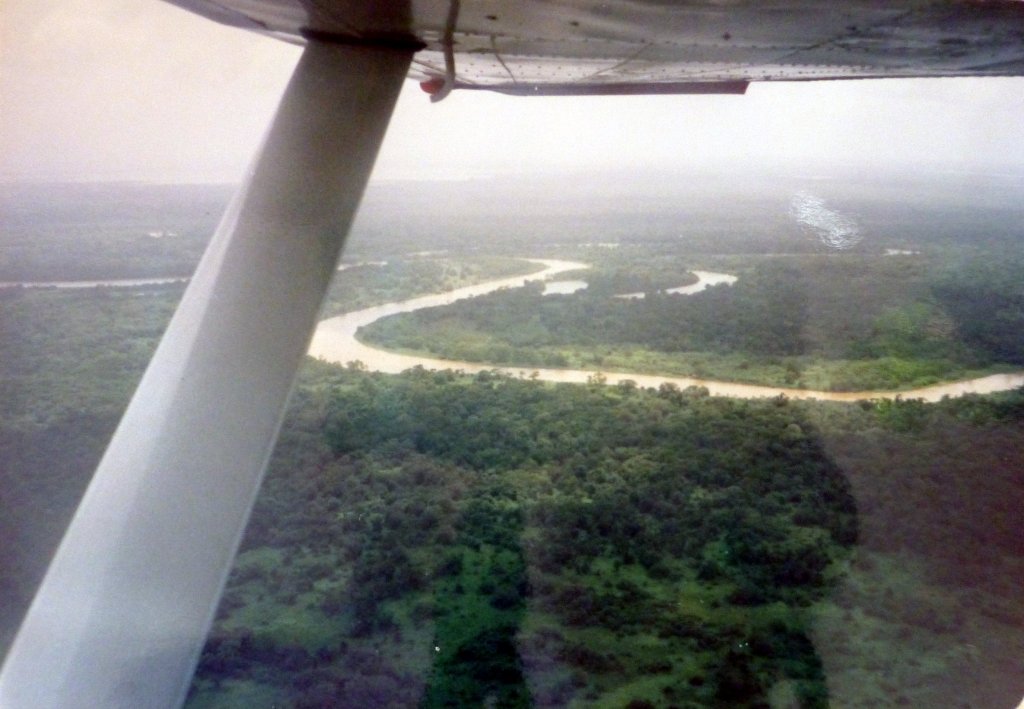
On the map we spot a river, Rio Patuca, the source of it arises deep in the interior of the Country and flows into the sea on the Caribbean coast. Navigating up this river might be an exciting trip. However, we do not know whether this is really doable. On Utila we find no one who can give us any information about the area. So we head back to La Ceiba. In a travel agency we finally get some useful info on how to get to the area. There is no way to fly directly to the mouth of the River, but one Airline flies regularly from La Ceiba to a small village, called Brus Laguna, which is near the river. There we should be able to hire a canoe that takes us to a village at the mouth of the Rio Patuca. But they don’t know if the river is navigable, nor if there is another way to get any further from there. Doesn’t matter, we do it anyway. So we go ahead and buy two tickets. The next day we go Shopping for a few essentials we might need for our trip into the unknown. We buy mosquito nets, mosquito spray, candles etc. We don’t take any food with us, only one bottle of water each cos we expect that if the river trip is really feasible we can supply in the villages along the river. The next morning we`re up at 5:00 am, and at 6 we are already at La Ceiba airport. We feast on a big breakfast before departure because who knows when there will be the next meal!? 7.15 liftoff in a 15 seat airplane. It`s about 1 hours flight at 2000m cruising altitude. The weather is sunny, slightly hazy, but the view from this low altitude is terrific. Then we`re landing on an unpaved, bumpy natural runway in Brus Laguna. Shit now that was a shaky landing, happy to be safe on the ground. With us, three more people get off, and the plane flies on to Puerto Lempira. A few locals stand around observing us curiously, and there is also a jeep, our taxi. But the driver doesn’t want to go to town as yet, he wants to wait for the next plane to arrive in order to be able to drive even more passengers into the village. So we wait, sitting on our backpacks in the shadow of a small hut.
And indeed, a little Chessna flies in half an hour later. The couple who exits the plane joins us on the 5 km drive to the village and on to the lagoon where some canoeists are already waiting for customers.
One of our fellow passengers is going to the same village as we do and he seems to know his way around here. He organizes a motorized canoe with driver for the three of us. It does not go all the way to our destination but only to the far end of the lagoon. Doesn’t matter, says our companion, from there we can continue on foot, along the beach to Barra Patuca, our destination for today. An hour later everything is settled and we set off in the 4 meter long, one meter wide canoe across the lagoon. The lagoon is huge, the size of a lake. On the other end we enter a River and head up a few more km. In total it`s a 3 hour journey and we pay 10 Lempiras = $ 3.5 each. Its now already 1:00 p.m and we still have a long walk ahead of us. Backpacks on and off we go, in the hottest heat of the day, barefoot along the deserted, kilometer-long sandy beach. Our companion says if we want to arrive before dark we have to go faster, it is relatively far to the village. The beach is full of washed up plants and dead wood, everywhere small streams flow into the sea and turn the water brown. No civilization- filth, no plastic to be seen, completely untouched wilderness. After a few kilometers I can feel my shoulders starting to hurt, I am no longer used to carry a 15 kg backpack for long distances. My feet also hurt after a while because of the salty sand. Then, after a seemingly endless walk, our companion says its just 2 more km, and, finally the first house appears. After about 20 km and a 3 hours walk we are completely exhausted. So we take a break before the final sprint. We find some coconuts in the sand and open a few with my pocket knife, very strenuous, but refreshing. Luckily we took water with us otherwise we would have been really fucked. Anyway we arrive in town. but there is no hotel, pension or any type of accommodation in the village, so our companion takes us to the church where two old Spanish pastors live. He reckons they’ll organize a shelter for us. With this he says goodbye and goes his way. The pastor is surprised to see two white Backpackers suddenly walking in. Without a hello or welcome he asks how we got here and whether we got lost. Minutes later the second pastor also appears, so we tell them why, what and about our plan. Later they provide us with a hut, which is actually the school room, where we can leave our Backpacks and string up our hammocks. Barra Patuca is a small fishing village of about 3000 mainly black inhabitants, of which 2000 appear to be children under the age of 10. There is no restaurant, no Comedor, nothing except a few small shops with a very limited stock.
So we ask the pastor where we can go for dinner. We haven’t eaten anything since breakfast. Since there is no official eatery anywhere he sends a boy to tell his mother to cook something for us. We relax a little and wait in our hut until the boy picks us up and leads us to his home. On the way we are eyed from all sides as if we were extraterrestrials. Most of the people, it seems, have never seen whites except for the two pastors. Finally something in the stomach: rice, Frijol, with liver and coffee. The woman is very friendly and keeps replenishing until we’re full. We thank her for the delicious food and give her a few Lempiras. Judging by the look on her face, we give far too much. But hey, it made her happy. Back in the hut we go to bed early, we are totally exhausted.
The next day we meet a man with whom we drank a few beers yesterday while on a stroll. He invites us to his house for lunch. Wow, people are so nice here. We are served rice, frijol and fish. So far, fish has never really been my favorite, as it is also not a common dish in Switzerland, (at least in my time) but after this super tasty fish that is served here, I really got a taste for it. We ask our host, Isidro is his name, and his father whether it is possible to navigate the river up to Ahuas, our planned first stage. It looks like the Cayucos = what they call the motorized canoes, leave very irregular. Anyway, nobody’s heading upstream today. It is also not possible to charter a canoe with a driver for both of us, firstly because it is difficult to find someone to take us and secondly because it is far too expensive. So we wait and spend another day in town. Maybe there will be someone who will take us along tomorrow. Isidro wants to show us his village, so we go for a walk. The village is right at the mouth of the Rio Patuca and as I said before, everything is very simple and poor. People live in small wooden houses on stilts, without electricity and running water. Electricity is only available from generators, and only in some shops.
People’s live is very leisurely, they only work the real necessary, like repairs to the house, cutting a new Cayuco from a tree trunk or go out fishing, women work in the garden or do laundry down by the river. The children, well, they have to be schooled outside under a tree today because we gringos occupy the “school house”. In addition to fish, rice Frijol and yucca are mainly eaten here, sometimes a chicken. Maybe they also go hunting in the forest.
Money seems to play a minor role, which is probably better, because if a man gets his hands on some, it is immediately turned into Bier or liquor. After our walk we go to a shop to drink a lukewarm beer. Marius and I go back to our hut, Isidro stays and borrows 20 Lempiras from me. Ok, but only because you’re such a nice guy. He says he’ll pick us up later for dinner. In the evening, waiting for Isidro. He’s not coming, probably drowning my 20 L in Beer. So what we do? As I said, there is no way to simply go out and eat anywhere. So let’s go to Isidro’s home, see if he’s there. He’s not but his brother is there and he heats up some rice and yucca for us.
The next day we pack our stuff, say goodbye to the priests and walk down to the jetty. Unfortunately no boat today, again. Shit. We can’t wait another day, Marius`s tourist card expires in a few days which means he has to leave the country. How do we get out of here now? A man says we could fly to Ahuas and try there to catch a boat further up the river. Seems to be the only way. So we charter an airplane via the village radio. The flight is expensive for the short distance = 50 Lempiras = $ 17.5 per person, (remember we’re traveling on a real tight budget) but the plane flies exclusively for us and as it appears its really the only way out of here. We stroll through the Village to the grassy runway which is about 300 meters long and leads straight through the middle of the village. When no planes are expected, cows, goats, donkeys and horses graze here.
Waiting. At 12.30 we see our plane approaching. It is a small, fairly modern four-seater Chessna.
I am sitting next to the pilot in the front. We fly at only about 500 meter altitude, sometimes over flat swampy, other times rain-forest overgrown country . Brilliant view. After a 15 minute flight, landing on Ahuas sandy bumpy runway. We jump out, and the pilot heads on straight back to his home-base, wherever that is. Here, a little village it is again. But no, this time its even smaller. Approximately 300 residents live here, in stilt houses. When looking for a place to stay, we ask in a few houses until someone tells us to ask at the hospital. Hospital? Here in this tiny village. Yes, the only one in the area run by an American doctor. We meet his wife and she organizes a room for us near the hospital. We can stay there for free. This time there is something like a Comedor in the village where we can eat. Rice, Frijol and, for a change, mozzarella with tortillas for 2.50 L. The beer, cold, but for the same price as the food. Bad news, again no boat in sight for the next few days. Well, that’s it for our trip on Rio Patuca. Too bad. We just don’t have enough time to do it.
So we have to switch to flying again. Only, tomorrow is Sunday and there is no plane. But if everything works out we can fly to Tegucigalpa on Monday.
Sunday we chill in the village. Monday morning we’re up early, have coffee at the neighbors house and then walk down to the runway. There is a small house on the edge of the slope ¨Officina Aereo¨ and in there sits a guy in front of his desk and radio-set. Today there is no flight from Sami Airline to Tegucigalpa he says. And, since the batteries on his radio are down, he has no contact with the outside world whatsoever. Therefore he does not know whether an airplane might be flying in today or not. Apart from this info he doesn’t seem very interested in helping us in any way. Well then, back to the village to the office of another airline, the Sosa. Same here, no flight today. Someone tells us a plane from Sami Airline is supposed to fly to Puerto Lempiras today, but nobody knows when it arrives here. Back to the airport in spite of everything, hoping there will be a plane flying in from anywhere going somewhere. . In any case, we buy a ticket from the unfriendly guy in the shack for $ 10. We must pay in $ because we have not much Lempiras left.
Back to the village for breakfast, always keeping an eye on the sky. As we return to the runway, an airplane is just landing. The wrong one, it is from the Local Mission. The pilot would give us a ride, but far too expensive. The next one that flies in is an unscheduled charter plane from Sosa Airline that brings a few US doctors who want to help out at the Hospital for a while.
The plane comes from La Ceiba and flies back there. I ask the pilot if we can fly with him. OK. Fantastic. We return our tickets we bought before and get on the little machine. After two short stops in small villages we arrive at La Ceiba. The flight cost us 84 Lempiras p. P.
Taxi to the center, change money and off to the bus station. Bus to San Pedro Sula, change Bus there and continue straight on to Tegucigalpa. 10 pm arrival. The next bus to the Nicaraguan border does not leave until 4 a.m. Instead of going to a hotel, we decide to wait in a 24 hour restaurant. After days of rice and Frijol we treat ourselves to a delicious Filet Mignon!
Well, that was our unsuccessful adventure up the Patuca River. Didn’t work out, but it was still an interesting and eventful trip
On Marius`s last visa-day we departure Honduras and enter Nicaragua.
 driftingvagabond.com