Border crossing Paraguay to Brazil in small town Bella Vista
There is not really an official border crossing. One town, two countries, the main road is the Border. No customs, no barrier, nothing. But I need an exit stamp from Paraguay and an entry stamp for Brazil so I go in search for the customs office. After some asking around I finally find a little shack which represents the Brazilian customs office. Closed. Opens only at 2 pm. Well then, I go looking for the Paraguayan immigration office, in vain. No one seems to know anything about an immigration office.
Well, back to the Brazilian office. Its past 2, the office is open and the customs officer gives me 90 days stay. So I cross the (non existent) border to Brazil without a Paraguayan exit stamp, well, I don’t really need it either, hopefully. Off to Brazil, new country, new language. It’s been a long time since I’ve traveled to a country where I don’t speak the language. However, after a short time I realize that I understand relatively much because Portuguese ( I call it Brazilian) is spoken very clearly and is quite similar to Spanish.
From Bella Vista I continue by bus via Campo Grande to Corumbà.
My destination: The Pantanal! which is located in the southwest of Brazil, bordering Bolivia and Paraguay. Corumbà is a medium-sized city located on the edge of the vast marshy area, the Pantanal, one of the largest wetlands on earth.
With an area of about 230,000 km², it is almost as large as Great Britain or the state of Utah in the US. Although in 2000 UNESCO designated the Pantanal Matogrossense National Park and three adjacent private protected areas as World Heritage Sites, and parts of the species-rich wetlands are protected,
unfortunately there is still a lot of destruction and exploitation going on.
The Rio Paraguay has a gradient of only 30 meters on its 600 kilometer long way through the lowlands of the Pantanal. Therefore, the water that flows into the basin via numerous rivers can leave the area only very slowly in a southerly direction. Thus, once a year, during the rainy season from November to March, large parts of the lowlands are flooded and two thirds of the area are partially submerged under meters of water. This creates lakes and shallow lagoons, extensive flooded areas, Rain forest-like riverside forests, dry forests and a wild maze of rivers.
I check in to a hotel in Corumbà where I meet a few other backpackers who are already staying there. The city seems to me like a furnace, it is extremely hot! but fortunately with low humidity. I talk with two Germans who are also looking for a guide to take them on a tour through the swamp. We walk through town asking in Travel Agencies, Hotels and Hostels until we find a local who agrees to guide us. He speaks Spanish and a few words of English. He advises us to find a few more people to join, this way it would be a lot cheaper for everyone. We ask an English couple from our hotel and they happily agree to come along . Five people, should give us a fair price each. Since I am the only one who can communicate with the guide in Spanish, Walter is his name by the way, I take over the negotiations with him. After everything is settled we pay a deposit and then are being instructed what to take with us on the trip. Most of the prep is done by Walter, who, as he says, is an experienced guide. Among other things, he plans the itinerary in the swamp, organizes an additional guide, a vehicle, the place were we are going to stay , the food, a cook etc. We don’t really need to take much with us, just a few personal things.
On the day of departure we go to the agreed meeting point. There are about twenty Israelis standing around who seem to be waiting for something. Well, they will probably also make a tour, I think to myself. When Walter drives up in the all-terrain vehicle, he greets us, walks over to the Israelis to also greet them. I take him aside to talk, I want to know what’s going on, whether the group is coming with us. Yes, he says. Shit, we had agreed that we are only five people and now we should go with a horde of noisy Israelis. I get really angry and tell Walter that was not what we agreed upon and we don’t want to go on this trip in a big group, but as agreed only the five of us. Unfortunately that’s not possible, everything is already organized, he says, but we shouldn’t worry it will still be good because we won’t be in a big group the whole time. Well, we will see. Too bad that the man does not stand by his word. Well, I can’t change it anymore and the Germans and the couple don’t seem to care too much.
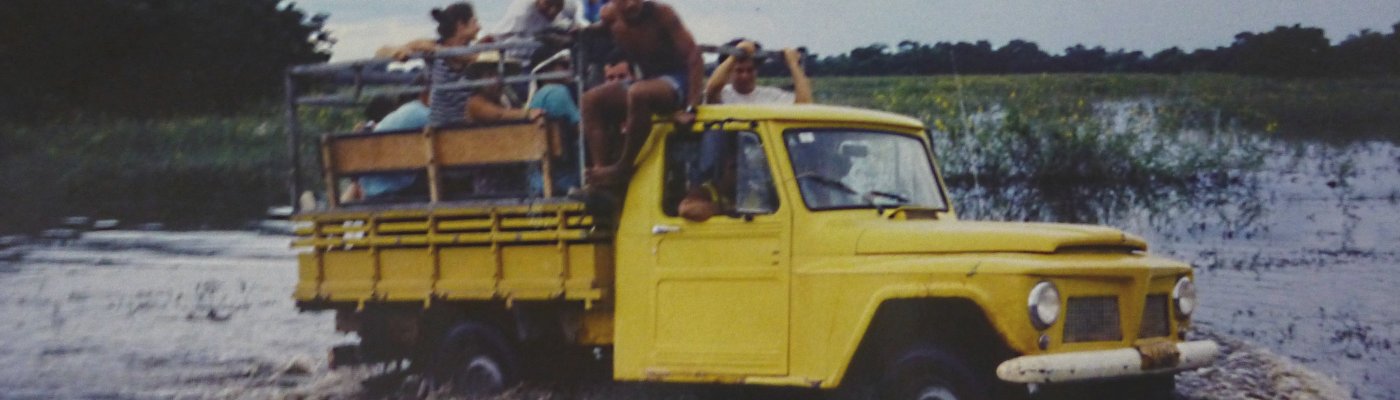
So off we go, off into the wilderness, not with one, but with four off-road vehicles. First a short way on paved road, then unpaved and later only trails. From time to time, the vehicles cross ponds, the water reaches just below the loading area. Suddenly one of the vehicles gets stuck and can no longer free itself. The driver calls a nearby Farmer over the radio to come and help us to pull the vehicle out with a tractor . An hour later we continue, and after a few more hours driving through the marshes we reach the campsite. A house, respectively a roof on wooden beams, wooden board walls only half-high, instead of windows fly screens have been drawn in, the door is only a frame with fly screens. But everything makes quite a solid impression. The room layout inside is in the same construction method. The furniture consists only of a few bunk beds, a few tables and chairs. The five of us are assigned a big room with 3 Bunk-beds , the Israelis take over the rest of the house. The crew, now about 7 men, have their own, smaller cottage right next door. The chef prepares our meals outside under a simple roof. We will stay here three nights, fortunately the Israelis only two, they are really noisy as hell.
We`ll make excursions from this base on foot, on horseback, or in vehicles. The guides lead us to places where we can see different types of animals, and scenically interesting locations. The landscape is extremely diverse, from Savannah, to Forrest, small and large water surfaces, ankle-deep flooded areas to meter-deep pools and everywhere it is teeming with animals and insects. There is also some livestock freely scattering. At night it is swarming with bloodsucking bats and insects , and definitely too many mosquitos
On the last day we are only the two Germans, Walter and me. On the way back to town I tell Walter that before the end of the trip we want to go piranha fishing, as we agreed before the trip. Walter doesn’t seem too exited, he just wants to go home. But I insist vehemently on our agreement until he finally gives in and drives us to a small lake. He organizes from someone he knows a small rowing boat, fishing gear and chicken meat. Well equipped we row to a slightly quieter place of the lake. Today is Sunday and it`s really busy around the lake . People swim and water ski in the apparently piranha-infested water. Aren’t these bathers being attacked by the carnivorous fish I want to know from Walter. No, that only happens in Hollywood he says dryly. As long as you don’t have a bleeding wound, your ok.
Unbelievable how easy these fish are to catch. I hold the line only a few seconds in the water and already got a bite. The difficult thing is to get the snapping fish off the hook without getting a finger bitten off. You first beat it to death with a stick and wait until it stops moving before you can safely remove the hook. We pull out a total of 6 big ones and three smaller ones in a very short time. That’s enough for a good meal. Walter drives us back to Corumbà to our hotel where we pay him the rest of his fee and say goodbye to him. At the hotel the owner prepares the fish for us with some rice and cassava.
Conclusion; The Pantanal is one of the most impressive landscapes I have ever seen and especially impressive are the many animals you can see in this open area, much more than in a closed tropical jungle.
 driftingvagabond.com