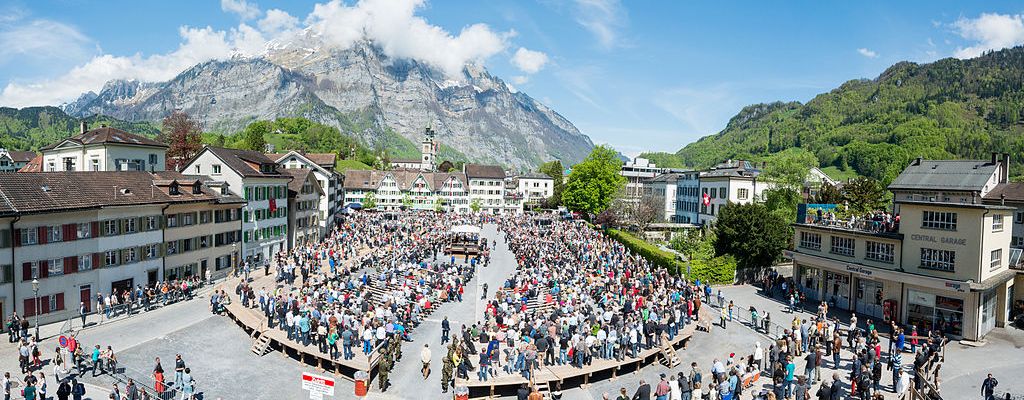
The Glarner Landsgemeinde offers a rare glimpse into Europe’s oldest living form of direct democracy
This blog post provides insight into the Glarner Landsgemeinde and its significance for Swiss democracy. It is a tradition that fascinates not only the citizens of Glarus but also international observers.
Every spring, the heart of Glarus transforms into an open‐air parliament: the Glarner Landsgemeinde, where citizens—and curious visitors from around the globe—witness one of Europe’s oldest surviving assemblies of direct democracy. On 4 May 2025, roughly 8,000 eligible voters converged on the Hauptplatz to cast ballots by handraise, debate hot button issues, and swear in newly elected officials. Here’s why this centuries old ritual remains both relevant and inspiring today.
Origins: From Medieval Roots to Modern Rights
13th century beginnings: The Landsgemeinde traces its lineage to the medieval village gatherings where free men decided on communal affairs, settle disputes, allocate communal resources, and elect leaders.
Constitutional Anchor (1836)
Although its roots run deep, the Landsgemeinde was formally enshrined in the cantonal constitution in 1836, fixing the date (first Sunday in May) and procedures that persist to this day.
Youthful inclusivity: In 2007, Glarus became a trailblazer by lowering its voting age to 16, empowering young voices in the process.
Landmark Moments in Landsgemeinde History
1848 Federal Shift
Delegates at the Glarus assembly endorsed the new Swiss federal constitution, reshaping the nation’s political landscape.
1938 Flood Response
Confronted with imminent flooding, the assembly swiftly mobilized resources—demonstrating the agility of face‑to‑face decision‑making.
1996 Environmental Vote
A razor‑thin margin on river‑cleanup measures prompted multiple hand counts, underscoring the assembly’s commitment to accuracy and transparency.
Anecdotes That Define the Spirit
Hat tossing: In the 19th century, a popular custom allowed a voter whose motion failed to toss his hat sideways—an informal symbol of protest still remembered in local lore.
The Silent Orator
Legend has it that a farmer once waited five full minutes in silence before speaking, reminding voters that listening is as vital as speaking.
Weather Wager of 2005
Two orators bet on whether the assembly would be rained out—loser treated everyone to Glühwein at the post assembly gathering.
The Assembly Process: Simple, Transparent, Immediate
- The Gathering
Citizens sit on wooden benches in a ring around a raised platform. A ceremonial bell marks the start of the assembly. - Nominations & Elections
Candidates—from the Landammann (governor) to members of the cantonal courts—are proposed from the floor. Votes are cast by hand‑raising (Handmehr), with results declared on the spot. no ballots, no booths. - Public Debate & Voting on Issues
From transportation subsidies to local initiatives, every motion is debated aloud. A simple show of hands (or multiple counts, if needed) determines the outcome.
Community Celebration
After the formal proceedings, citizens mingle at local cafés, turning civic duty into communal festivity.
The Last Assembly: 4 May 2025
On 4 May 2025, some 8,000 eligible voters gathered on the Hauptplatz in Glarus to:
- Elect key office holders by a show of hands (Handmehr):
- Elect Regierungsrat (executive council)
- Judicial posts
- Swear in the executive council
- Debate and decide on several policy motions—including the retention of free public transport for participants and the rejection of a proposal to extend local voting rights to non Swiss residents.
The assembly ran from morning until mid‑afternoon, punctuated by spirited speeches and the unmistakable sound of the Landsgemeinde bell calling voters to order.
Why the Landsgemeinde Matters today
The Glarus Landsgemeinde is more than a quaint relic—it’s a model of how direct engagement, transparency, and community-building can thrive alongside representative institutions. For democracies worldwide grappling with apathy and disengagement, the unfiltered, face‑to‑face ethos of the Landsgemeinde offers lessons in trust, accountability, and the simple power of citizens deciding their own fate. For democracies worldwide grappling with voter apathy, the Glarner model offers a compelling vision: an assembly where every voice is seen, every vote is counted in real time, and every citizen has a place under the open sky.
 driftingvagabond.com