A Journey Through the Heart of Indonesia
Ramadan in Aceh: Welcome to Another World
The speedboat from George Town to Medan cuts through the tropical waters of the Strait of Malacca. my first step into Indonesia. A new chapter begins – Sumatra, the world’s sixth-largest island, awaits with its secrets. In Medan, this chaotic “dirty city” and capital of North Sumatra, I meet Bruno, a Swiss traveler with similarly insatiable wanderlust. We decide to team up and travel together to the North of the Island
With an exchange rate of 1 US dollar to 2,100 Indonesian rupiah, we feel like millionaires.
Aceh – Indonesia’s most conservative, most Muslim province. And this right during the last week of Ramadan! What a cultural shock. I’m learning the hard way what that means. You can buy food and drinks during the day, sure, but eating or drinking in public? Absolutely forbidden. I tried to light a cigarette this morning and got such angry stares I thought I was about to get lynched. Every restaurant is closed from sunrise to sunset – for an entire month. The locals take this seriously, though I’m already discovering that many sneak around to smoke and drink in hidden spots. Even sex is supposedly taboo during Ramadan. The hypocrisy is fascinating and slightly amusing.
Into the Mountains: Bireuen to Takengon
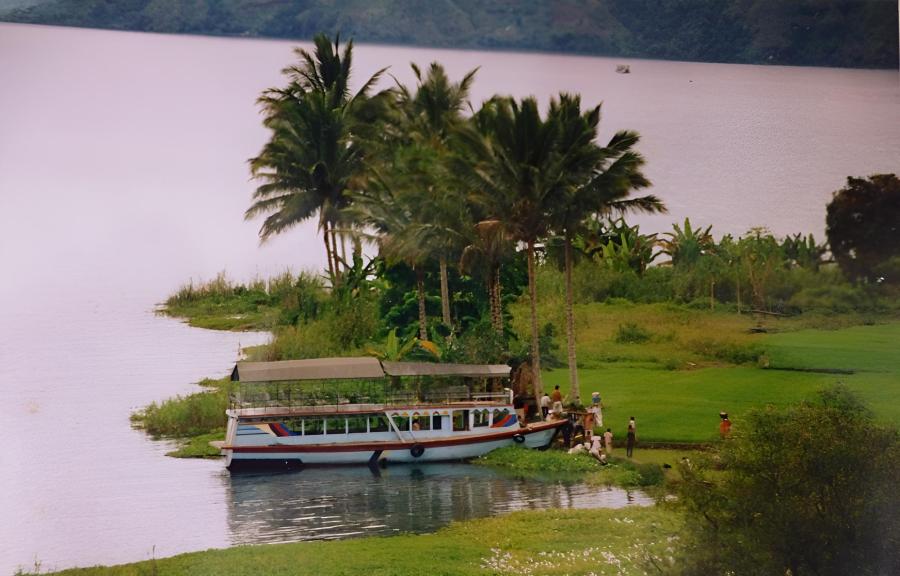
We made our way north to Bireuen and spent the night there. Nothing special about the town, but it’s a good base for reaching Lake Danau Laut Tawar near Takengon. The lake itself is stunning – a clear mountain lake at 1,200 meters elevation, surrounded by coffee plantations and hills where the Gayo people have lived for centuries.
In Takengon, we met Charles, an Englishman who seemed as eager as we were to explore the more remote parts of Sumatra. He joined our little group, and we discovered something interesting: despite all the Ramadan rules, every town has at least one semi-hidden restaurant where local men gather during the day to eat, drink (non-alcoholic stuff), and smoke. The whole thing is pretty hypocritical, but I’m not complaining – at least we can get food.
The Road to Hell: Getting to Ketambe
I need to document this journey to Ketambe because I genuinely thought we might die twice. We took a minibus through what locals generously call “roads” but are really just tracks carved through virgin jungle. The scariest moment came on a hairpin curve where our bus tilted so far to the side that I could have touched the ground by reaching out the window. Below us was a 100-meter drop into nothing.
We got stuck for hours because of landslides – apparently a regular occurrence here. At one point, the pavement was completely washed away, and our bus had to squeeze past with all passengers getting out first. Welcome to Sumatra, where every journey is an adventure you might not survive.
But we made it to Ketambe, a tiny village on the edge of Leuser National Park. We’re staying with a local family for 2,500 rupiah per person – their son works as a trekking guide. The three of us share a simple room, and honestly, it’s perfect.
Jungle Days: Leeches, Monkeys, and Hot Springs
We’ve spent the last few days trekking through some of the most incredible jungle I’ve ever experienced. The Leuser National Park is what rain-forest should be – completely untouched, overwhelmingly alive, and slightly terrifying. The humidity hits you like a wall, and within minutes you’re soaked in sweat. Leeches are everywhere, these sneaky little vampires that attach to your legs without you feeling anything.
Yesterday I watched a group of macaques playing in the trees just 100 meters from where I was sitting. Green snakes hang motionless from branches, and the bird life is incredible – flashes of brilliant color darting through the green canopy. We found hot springs that flow directly into a river, and I spent an hour just soaking in the natural pools, surrounded by jungle sounds.
What strikes me most is how our guesthouse sits right at the forest edge. In the evenings, we eat dinner in what’s essentially the family’s living room, and we can watch monkeys in the trees while we eat. It’s like being in a nature documentary, except the mosquitoes are real and the humidity is relentless.
Lake Toba: Batak Culture and Tourist Reality

After saying goodbye to Charles who went back to Medan to catch his flight to England, we headed south to Lake Toba via Berastagi. Toba is massive – this volcanic lake was formed by what scientists say was the most catastrophic explosion in human history, about 74,000 years ago. We took the ferry to Samosir Island in the middle of the lake.
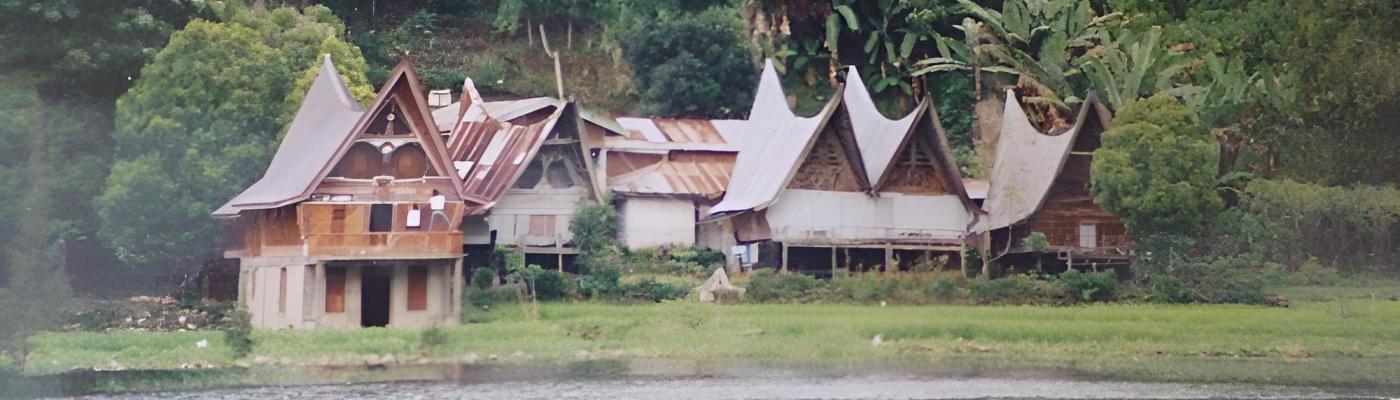
The Batak culture here is fascinating. These are proud people with their own language, unique architecture (those distinctive saddle-roofed houses), and musical traditions that go back centuries. Bruno and I rented bicycles and spent hours cycling through rice terraces that look like green staircases climbing the hills. Every village we passed, kids would run out shouting “Hello Mister!” – it never gets old.
I have to admit, Lake Toba is more touristy than I expected, but it’s still authentic in many ways. The mountain reflections in the deep blue water are stunning, and staying right on the lake-shore for 2,500 rupiah per person feels like luxury after the jungle.
Here I also connected with two female friends I’d arranged to meet – now we’re a group of four heading further south.
Nias Island: Surfer Paradise and Ancient Culture
The boat journey from Sibolga to Nias took eleven hours, but it was worth every minute of seasickness. Nias is something special – an island that feels like it exists in its own time zone. The culture here is unique, with megalithic stone sculptures and jumping rituals that showcase incredible athleticism and bravery.
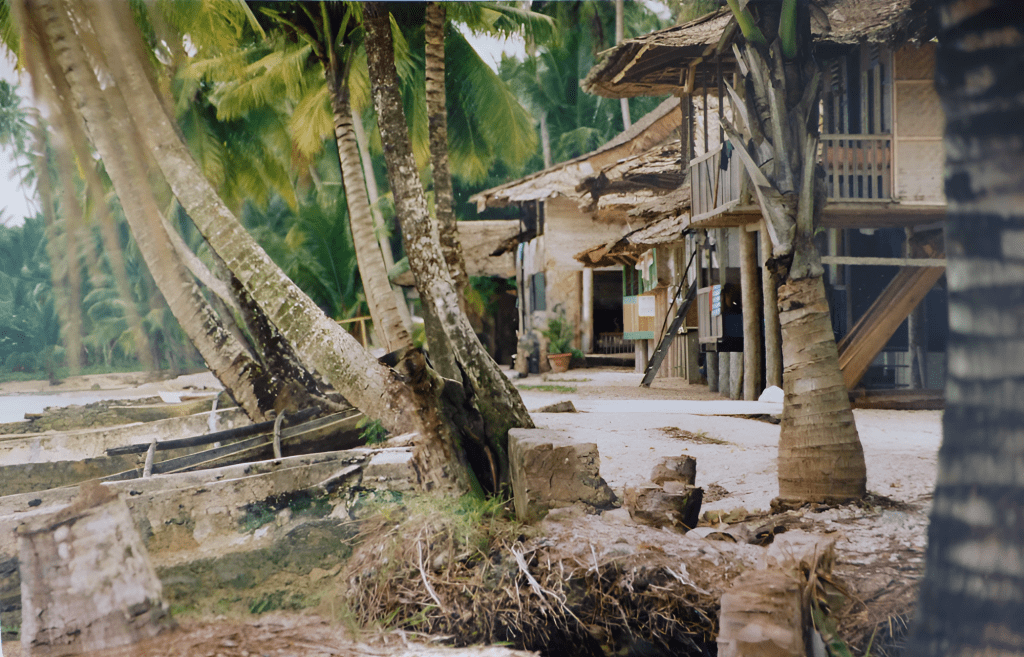
We’re staying at Lagundi Beach, which is legendary among surfers for its massive waves. Our beach guesthouse costs just 500 rupiah per person (about 25 cents!) and sits right on the sand with a terrace overlooking the Indian Ocean. The waves here are consistently huge – I can see why surfers travel halfway around the world to get here.
My days have fallen into a perfect rhythm: morning swims in the warm ocean, buying fresh fish directly from fishermen who bring their night’s catch to the beach, then having it cooked at our guesthouse for a few rupiah. The lobster here is incredible, and at these prices, I’m eating like royalty.
We’ve also visited traditional Nias villages, which are like living museums. Houses on stilts, intricate wood carvings, and village elders who still remember the old ways. Last night we attended a festival with traditional dancing and singing. The men perform these jumping ceremonies over stone blocks two meters high – it’s a test of courage and skill that’s been practiced for centuries.
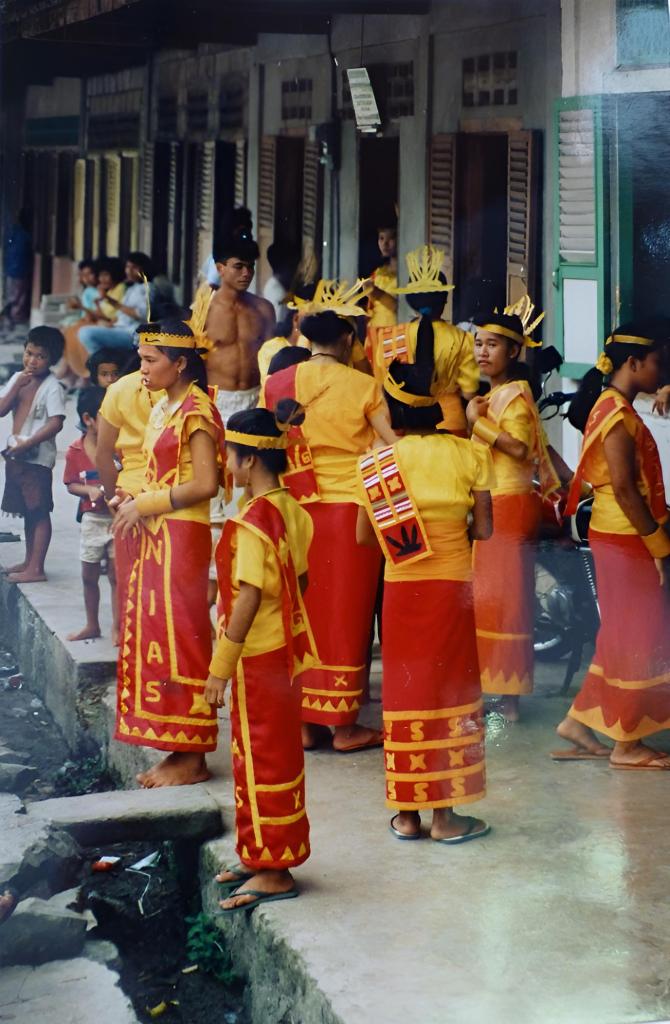
What I love most about Nias is that it’s not overrun with tourists yet. The other travelers here are mostly young, relaxed backpackers, and the locals are genuinely friendly rather than just seeing dollar signs. It feels like a real paradise for unwinding.
Leaving Paradise: The Return Journey
After about a week in paradise, it was time to move on, though leaving proved complicated. No boats on Sunday, none on Monday – typical for remote Indonesian islands. Finally I got word that there’d be a departure Tuesday at midnight. To make matters worse, I got food poisoning, probably from an undercooked egg. Spent Monday feeling terrible, but by Tuesday I was functional again.
The return journey to Sibolga was an adventure in itself. Bruno had already left, but the five of us, my two female travel companions and two other backpackers, managed to get on an overcrowded wooden ship with no cabins available – not even bunks. We made ourselves comfortable on the stern deck, which at least offered some wind protection.
These traditional Indonesian boats are works of art – hand-carved decorations, bright paint jobs, and construction methods that haven’t changed in centuries. They’re not comfortable, but they have character and somehow always get you where you’re going.
The weather turned rough during the nightly crossing, with rain and decent waves that had the old wooden ship creaking and rolling. Eleven hours on a hard deck isn’t exactly luxury travel, but it’s all part of the Indonesian experience.
Mountain Lakes and New Discoveries
From Sibolga we made our way to Bukittinggi, then continued to Lake Maninjau – another volcanic lake, but much less touristy than Toba. This place feels completely untouched by the outside world. Our guesthouse sits right on the water, and I wake up each morning to mist rising from the lake while herons fish in the shallows.
The steep mountains surrounding the lake create this incredible natural amphitheater, and small fishing villages dot the shoreline. Time moves differently here – fishermen paddle out in traditional boats, women wash clothes at the water’s edge, and children play in the shallows. It’s the kind of place that makes you want to stay forever.
Solo Journey South: Real Indonesia
This morning I said goodbye to my travel companions and caught a bus back to Bukittinggi, then continued toward Padang. The capital of West Sumatra is a proper port city where you can feel the mix of cultures – Malay, Indian, Chinese all blended together. This is where the famous Padang cuisine comes from, with those incredibly spicy curries that challenge even experienced spice eaters.
Now I’m on a bus heading south along the coast, and I’m definitely the only foreigner around. Every time we stop, people stare at me like I’m an alien. Children point and shout “Hello Mister!” from every village. The landscape is pure Indonesia – endless rice fields interrupted by small villages where houses stand on stilts.
Jungle Breakdown: When Plans Go Wrong
I’m writing this by candlelight in Sungai Penuh, and I need to record what just happened because it was both terrifying and somehow typical of Indonesian travel.
Yesterday evening I reached Pasar Tapan and caught a bus heading inland toward Sungai Penuh. The bus didn’t leave until 10:30 PM – Indonesian scheduling – but I was getting used to that. While waiting, I practiced my Indonesian with some local guys. The language isn’t too difficult once you get the hang of it – no verb tenses, relatively simple grammar. It’s mostly about learning vocabulary and making connections.
We were driving through complete jungle in the middle of the night when everything stopped. I got out to see what was happening and found a scene of total chaos: a landslide had blocked the road with fallen trees and mud. In the headlights of the lead truck, men were working with axes and shovels to clear the way.
What I thought would take an hour turned into an all-night ordeal. Just when they cleared the trees, a truck got stuck in the mud and couldn’t move forward or backward. By dawn, there were maybe 15-20 buses and trucks lined up on both sides of the mess, right in the middle of virgin jungle.
Everyone was walking around discussing solutions, and I found the whole scene fascinating – Indonesian problem-solving in action. After several more hours, they finally managed to pull the truck free and we could continue. I spent maybe one hour total sleeping in that cramped bus.
When I finally reached Sungai Penuh, the first thing I did was find a proper hotel, take a hot shower, and sleep in a real bed for a few hours. Sometimes the simple pleasures mean everything.
The Final Push: Trains, Buses, and Indonesian Logistics
I’m now on my final stretch through Sumatra, and I have to say, this island has tested every bit of patience and flexibility I thought I had. From Sungai Penuh I retraced the same route back to Tapan (thankfully without landslides this time), then caught a bus south along the coast.
This particular bus journey was an exercise in extreme patience. We crawled along at maybe 15 kilometers per hour, stopping every few minutes. After several hours of this, I climbed onto the roof and made myself comfortable up there. Much better view, fresh air, and constant choruses of “Hello Mister!” from every village we passed. It took twelve hours to cover 200 kilometers – that might be a record for slow travel.
Bengkulu, the capital of the province, turned out to be a pleasant surprise – quiet, relaxed, with genuinely friendly people. From there I caught a bus to Lubuklinggau, then finally experienced Indonesian train travel. The “business class” turned out to be regular seats with ceiling fans, but after weeks of buses, it felt luxurious.
The overnight train to Palembang was comfortable enough, though I didn’t stay long in that industrial oil city. Another train brought me to Tanjung Karang, and now I’m preparing for the final step – tomorrow’s ferry to Java.
Reflections: What Sumatra Taught Me
As I prepare to leave Sumatra behind, I’m trying to process everything this island has thrown at me. This wasn’t just travel – it was education in patience, flexibility, and finding humor in chaos. Every day brought something unexpected, from Ramadan restrictions in Aceh to landslides in the jungle to perfect sunsets over volcanic lakes.
What strikes me most is how authentic this experience has been. Sumatra isn’t set up for mass tourism yet – when people stare at me or children shout greetings, it’s genuine curiosity, not calculation. The infrastructure is challenging, the distances are longer than they appear on maps, and nothing runs on schedule, but that’s exactly what makes it special.
I’ve learned to appreciate simple things: a hot shower after days in the jungle, a real bed after a night on a bus floor, a cold drink when restaurants finally open after sunset during Ramadan. I’ve also learned that some of my best memories come from the most chaotic moments – getting stuck in jungle traffic jams, sharing overcrowded boats with friendly strangers, communicating with hand gestures and broken Indonesian.
Sumatra changes you. It strips away expectations about comfort and efficiency and replaces them with appreciation for adventure and human connection. Tomorrow I’ll take the ferry to Java, but I know this island will stay with me long after I leave. It’s shown me what Southeast Asian travel can be when you get off the beaten path – challenging, unpredictable, and absolutely unforgettable.
 driftingvagabond.com