
1600 Kilometers Against the Current from Manaus to Leticia
After two months under the Brazilian sun of Porto Seguro and sleepy Arraial d’Ajuda, I’d had enough of beach life and salty sea air—I longed for something wilder, more unpredictable. The Amazon was calling, and I was foolish enough to answer.
The Journey to Manaus: A Trip Through Brazilian Aerial Bureaucracy
The bus ride to Salvador was uneventful, as was the taxi to the airport. But then began what I would later call “the great Brazilian flight torture.” My flight to Manaus turned out to be an absurd odyssey through the air corridors of the fifth-largest country on Earth: First down to Rio de Janeiro, transfer. Then on to São Paulo, another transfer. Finally, after two more stopovers and what felt like three days in plastic airport seats, I landed in Manaus—exhausted, dehydrated, and harboring a deep resentment toward Brazilian aviation planning.
I already knew the Hotel Rio Branco from previous visits. It was one of those establishments you don’t necessarily recommend but keep returning to because they’re reliably pleasant in their mediocrity. The air conditioning wheezed like an asthmatic, but it worked. The bed was hard but clean. Enough for an adventurer with modest expectations.
The Most Sinful Street in Manaus
In the evening, while out and about, I ran into a Dutchman I’d already met in Porto Seguro. Like two lost souls of the traveler diaspora, we decided to check out Manaus’s most notorious street—that place where the city’s night owls, fortune seekers, and desperate souls congregate.
Four restaurants lined the street, two and two facing each other, as if they’d arranged themselves for an architectural duel. We sat outside on the sidewalk at a table, ordered ice-cold Brahma beer, and watched the city’s nightly theater. Manaus at night is like an overripe mango—sweet, intense, and slightly dangerous.
Then I saw her: A woman I knew from my two previous stays in Manaus. A fleeting acquaintance, nothing more. When I was about to leave, I walked over briefly to say hello.
What happened next wouldn’t have been out of place in a bad Western film.
A drunk Englishman—red-faced, eyes glassy from too much cachaça—bellowed from inside the restaurant: “That’s my girlfriend! Stay away from her!” I tried to explain that I just wanted to say hello, really, nothing more, but the guy was already at operating temperature.
Before I knew it, he shot out of the restaurant like a cannonball, grabbed me by the throat, and yelled something about killing me. His breath smelled of cheap liquor and bad life decisions. I managed to break free, took a step back. Other guests jumped between us, held the crazed Brit back while he continued raging and writhing like an eel on dry land.
Sometimes discretion is the better part of valor. I disappeared toward the hotel, thinking to myself: What a lunatic. What idiots exist in this world.
The Preparation: Hammocks, Hope, and Hard Biscuits
The next day, I devoted myself to preparations for the actual adventure. On my list: buy food (mainly things that can’t spoil), acquire a decent hammock, and secure a spot on a ship to Tabatinga.
As I strolled through the harbor district, suddenly from a side alley about twenty meters ahead of me, a naked woman appeared—completely unclothed, disheveled, covered in dirt. She ran screaming across the street and disappeared just as quickly into another alley, like a disturbing urban ghost. The few passersby didn’t even bat an eyelash. Manaus has seen stranger things.
Had she escaped from a psychiatric clinic? Was she on drugs? Or simply one of the many lost souls living out their fate in the margins of this jungle metropolis? I would never know. The harbor district swallowed her story, as it swallows so many stories.
The port of Manaus is a microcosm of the Amazon—chaotic, vibrant, permeated by a peculiar smell of fish, diesel, and tropical vegetation. The floating docks rise and fall with the water level of the Rio Negro, which merges here with the Solimões to form the Amazon. I found a ship that was supposed to depart tonight at 6 PM.
A Canadian from the hotel had the same plan. We teamed up—two gringo adventurers against the mighty current.
Aboard the “Voyager III”: Welcome to the Floating Chaos
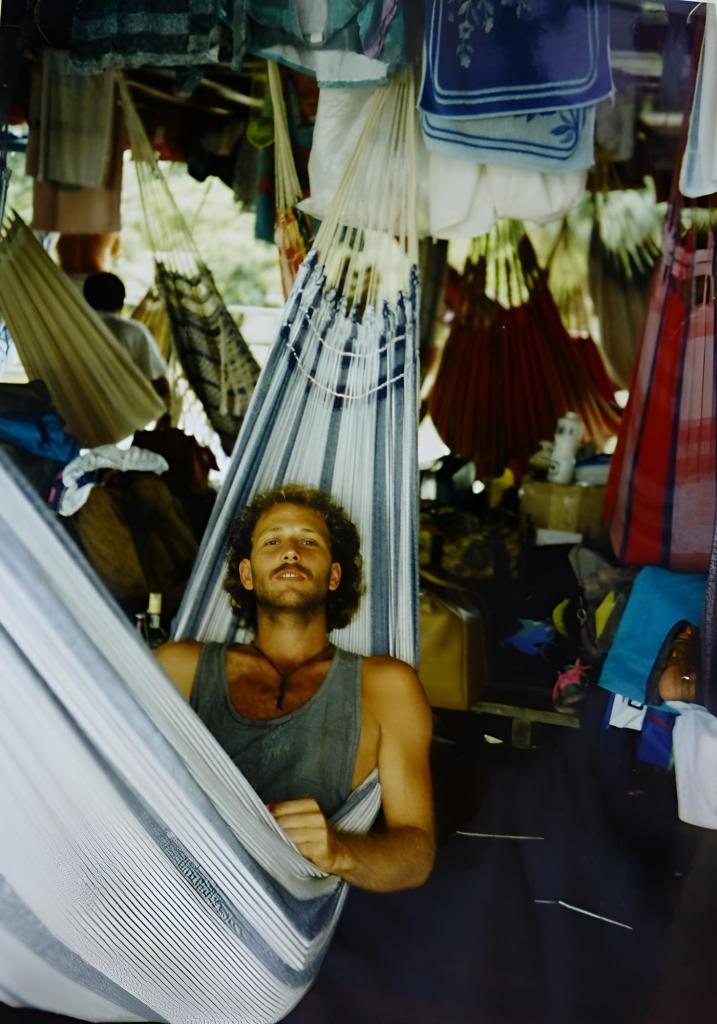
The ship bore the hopeful-sounding name “Voyager III” and looked like a cross between Noah’s Ark and a floating flea market. When we arrived at the port at 6 PM, dozens of passengers were already on board. The upper deck—the so-called hammock deck—resembled a textile labyrinth of colorful hammocks strung in all directions.
We met a German couple on board as well. The four of us were the only foreigners among Brazilians, Peruvians, and Colombians. We hung our hammocks in the last available spaces and tried to orient ourselves in this chaos of people, hammocks, and luggage.
The ship was about 30 meters long, a classic Amazon riverboat with two decks. Below were the cargo hold, kitchen, and a few cabins for the privileged few passengers who could afford a private room. Above, we reigned, the hammock class—the economy class of the Amazon.
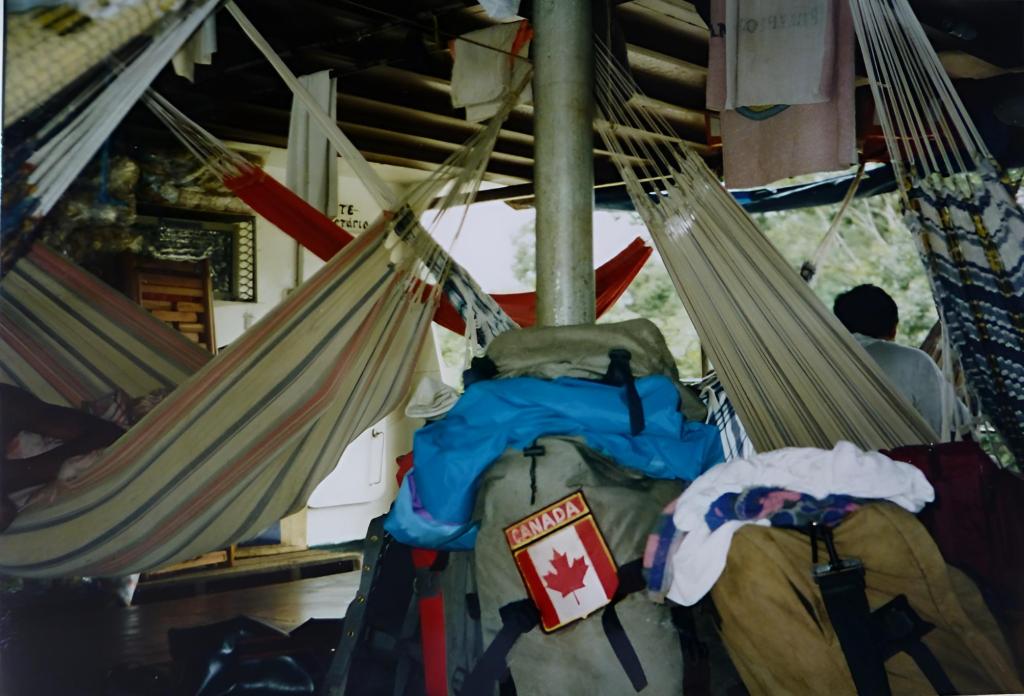
At 9 PM, the ship’s siren wailed, the engines roared to life, and we glided into the darkness of the world’s largest river.
Nine Days, 1600 Kilometers, Infinite Patience
The journey from Manaus to Tabatinga/Leticia covers about 1600 kilometers—upstream, against the current of the Amazon and its main branch, the Solimões. The trip was supposed to take nine days. Nine days in a hammock. Nine days with minimal infrastructure, without privacy, without possibility of escape.
The ship cleverly traveled close to the shore, where the counter-current is weakest. On a downstream journey, you’d travel in the middle of the river, but then you’d be too far from shore. This way, however, we could observe life along the river: the small stilt houses clinging to the muddy banks, the fishermen in their hollowed-out dugouts, the children jumping from the shore into the brown water.
The days merged into a sluggish rhythm of sleeping, reading, playing cards, and staring at the passing greenery. The rainforest stretched endlessly on both sides—an ocean of trees, interrupted only by occasional clearings. Giant kapok trees towered above the canopy, lianas hung like green curtains, and somewhere in there, invisible to our eyes, the true drama of the jungle was unfolding.
We saw pink river dolphins—the famous botos—surfacing beside the ship and disappearing again like pink ghosts. On the shore, domesticated water buffalo grazed, introduced by early settlers. Birds were abundant: macaws in brilliant red and blue, toucans with their absurdly large beaks, herons perched on tree stumps. Occasionally, you’d see bands of monkeys swinging through the trees—probably capuchin or spider monkeys.
The Jungle Villages: Civilization on the Edge of Forgetting
Along the way, we stopped at small settlements. Some bore melodious names like São Paulo de Olivença, Amaturá, or Santo Antônio do Içá—tiny dots on the map but lifelines for the people here. Others were so small they didn’t even have official names.
These places were strange hybrids of civilization and jungle. There were satellite dishes next to wooden shacks, refrigerators powered by generators, and streets that weren’t really streets but muddy paths that became rivers during the rainy season.
Sometimes we saw people emerging from the jungle—indigenous peoples or caboclos (mixed-race people) who lived deep in the rainforest and only occasionally came to the villages to buy necessities. They appeared like ghosts from another time, bought rice, salt, tools, and disappeared back into the green sea.
The Ship’s Band: An Acoustic Ordeal
The ship had a six-member band on board—two trumpets, an accordion, two guitars, and a drum set consisting mainly of upturned plastic barrels. Every time we docked at a port, the band started playing. And they played. And played. For hours.
The music was a mix of Brazilian forró, sertanejo, and something that could only be described as “Amazonian folklore hell.” Loud, repetitive, with lyrics about lost love, faithful dogs, and the hard daily life on the river. After the third day, I knew every song by heart. After the fifth day, I considered jumping overboard.
The band played for the entertainment of the villagers, I assume. It was their way of saying: “We’re here! The ship is here! Come and see!” And people actually came—children dancing on the shore, old men nodding their approval, women clapping.
For us passengers, it was a trial of biblical proportions.
Arrival at the Border: Where Brazil Meets Colombia
After nine days—nine long, hot, humid, musically tortured days—we finally reached Tabatinga. The city lies directly on the border with Colombia and seamlessly transitions into the Colombian city of Leticia. It’s actually one city in two countries—no wall, no barbed wire, just an imaginary line and different flags.
We arrived during the flood season. The streets near the harbor were flooded, the brown water stood knee-deep. You moved on elevated wooden walkways that had been provisionally laid over the water—wobbly constructions on which you had to slalom to avoid landing in the Amazon.
The four of us took a hotel room—frugal, as backpackers tend to be. The Canadian, the German couple, and I shared a room that smelled of dampness and whose fans turned wearily in circles.
The Shack: Bureaucracy at the End of the World
The customs clearance at the remote border post from Brazil to Colombia.
The “border station” turned out to be a wooden shack that looked as if the next strong gust of wind would blow it into Colombian territory. Inside sat two officials—one Brazilian, one Colombian—at wobbly desks littered with stamps, yellowed forms, and half-empty coffee cups.
The Brazilian official—a middle-aged man with a mustache and the relaxed demeanor of someone who has long accepted that the world will keep turning without his intervention—took my passport and studied it, leafed through the pages, read every single stamp, muttered something incomprehensible, then reached for one of his stamps.
“Bienvenido a Colombia,” he said with a crooked grin—in Spanish, even though we were in Brazil. Then he pointed with his thumb at his Colombian colleague three meters away.
The Colombian official asked several questions: Where from? Where to? Why? How long? Then he filled out three different forms—one for him, one for me, one for a mysterious third party whose identity was never clarified.
THUNK. Colombian entry stamp.
The entire procedure took about ten minutes—not because it was complicated, but because time had a different meaning here. On the Amazon, you don’t measure time in minutes but in rain showers and sun positions.
As I left the shack and balanced back to the village over the wooden walkway, I was officially in Colombia. Nothing had changed—the same flooded streets, the same wooden houses, the same curious glances. Only on paper had I crossed a border.
The Cargo Plane: A Flying Fish Warehouse
The other three stayed on as they wanted to take a jungle excursion in the area. I’d had enough of the rainforest and wanted to continue to Bogotá. The problem: It was the rainy season, and flights were rare and expensive. After a long search, I found the cheapest flight—on a cargo plane.
Yes, you read that right. A cargo plane.
I waited six hours at Leticia’s tiny airport, a building that looked more like a large garage. Finally, the flight was called. We—about ten passengers—climbed a wobbly metal staircase into a DC-3, an old-timer, seemingly from the 1940s.
Right past the entrance, the plane divided: left went to the cockpit, right to the cargo hold. The entire cargo area was filled with fish from the Amazon—huge, ice-cold, slippery piracurus, tambaquis, and surubins, unpackaged, simply thrown onto ice.
Most passengers had to sit in the back on the fish. Directly on the fish! Some had brought blankets or plastic bags to avoid having to sit on the cold, wet fish. In front, in a narrow corridor between cockpit and cargo hold, there were three folding seats occupied by three elderly women.
I remained standing in the corridor. No seatbelts, no handholds, no safety briefing. It was like riding a bus—only at 3000 meters altitude.
During takeoff, I went to my knees, desperately looking for something to hold onto. The engines roared, the plane shook like an earthquake, then we lifted off. Through a small porthole in the door, I could see the rainforest disappear below us—endless, green, indifferent.
An hour and a half later—an hour and a half during which I called upon every god I knew—we began our descent. I went to my knees again, held onto the door frame, and hoped the tires would hold.
They held.
As I stepped out of the plane and felt solid ground under my feet, I was honestly relieved. That really wasn’t for people with claustrophobia or weak nerves. Just a tiny window, cold fish, and the constant awareness that between me and a crash stood only a few rusty screws and the skill of a pilot who was probably older than his plane.
A taxi took me to the center of Bogotá, to a youth hostel. There I sat on my bed, listened to the street noise of the Colombian capital, and thought: That’s it. The last time I fly with a fish cargo.
But as it goes with adventurers and their vows—we forget quickly. And somewhere, deep inside me, I knew: It wouldn’t be the last time.
 driftingvagabond.com