Following the Trail of the World’s Highest Waterfall
June 7th – Crossing into Venezuela
My internal alarm clock wakes me just in time to grab my backpack and dash across the street to the Rodoviaria of Boa Vista. The bus is running late! With my last few Cruzeiros I treat myself to a coffee and watch the bus station slowly come to life. Another tourist is standing there. An American from North Carolina, as it turns out. He’s heading to Venezuela too. We board the bus, and off we go through constantly changing scenery –large forested stretches, bare flat-lands reaching to the horizon then rolling hills. Nice, but nothing spectacular. After five hours we reach Brazilian customs. Passport stamped, and on to the Venezuelan border. Here we’re just registered – the actual entry stamp comes later in Santa Elena. We arrive at 1:30 PM – but immigration doesn’t open until 2. I exchange ten bucks at the bus office. Exchange rate: 1 US dollar to 65 Bolívars. Burt – that’s the American’s name – and I grab something to eat. First thing I notice: Venezuela is noticeably cheaper than Brazil. Especially bus travel – a twelve-hour journey runs about ten dollars here. In Brazil I’d have paid double or triple that. At 2 PM we get our stamps, and by 4 PM I’m back on a bus heading for Ciudad Bolívar. Twelve hours in an old, uncomfortable tin can ahead of me. Burt’s spending the night in Santa Elena.
The Gran Sabana – A Natural Spectacle
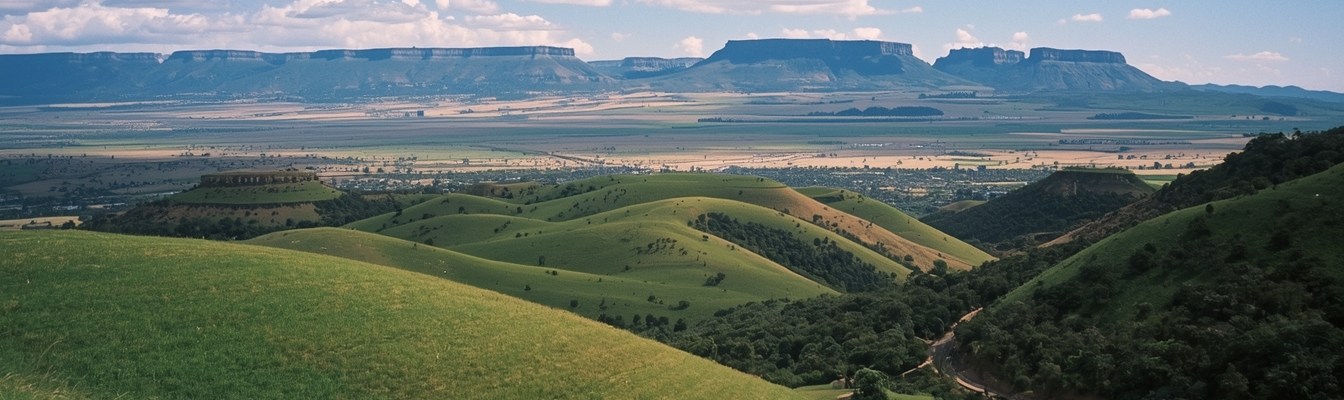
The bus rolls north into the Gran Sabana, and what I see takes my breath away. A stunning landscape unfolds before me: rolling hills, massive plateaus, and wide, sweeping valleys. Partly forested, partly just grassland – all of it in rich, luminous green.
Unfortunately it’s dark by 6:30 PM and I only catch a glimpse of this unique region. But I already know I’ll be back.
A Night Bus I Won’t Forget
The night gets… interesting. Sleep? Forget it. The bus keeps filling up with more people and small animals. And naturally, some huge, broad guy heaves himself into the seat beside me. I feel like a sausage in a hot dog bun. A few hours later, after a longer stop I ask him where he’s headed. “Ciudad Bolívar,” he says. Same as me – and we’ve still got five hours to go! Eventually some people get off and seats open up, I immediately switch and sit next to a woman who appears to be sleeping. Finally, room to breathe. As I am about to doze off I realize she’s not sleeping. Slowly she snuggles against me, her nose practically in my armpit. She seems to like my deodorant and presses her legs against mine. My pulse quickens. I carefully stroke her, which she seems to enjoy – until I touch her legs. Instantly she closes them and pulls away. Shortly after, though, she snuggles up to me again. This dance continues all night. Not a single word spoken, just these silent touches in the darkness of the bus. Just before Ciudad Bolívar she gets off with her companions who’d been sitting in front of us, and I finally see her properly in the light. She’s young, quite good looking. A fleeting encounter of nothing but touches. And that was that.
Ciudad Bolívar – Arrival at Dawn
Monday, June 8th – 4:00 AM, 28°C
The bus pulls into Ciudad Bolívar in the early morning. I kill time at the terminal until six-thirty, because if I check into a hotel now I’ll have to pay for two days. Too expensive. At 6:30 AM I grab a taxi for 100 Bolívars to the center, to Hotel Halia. Full up. I try Hotel Sicilia. The desk clerk wants to charge me for a full day even though it’s just a few hours until noon. Two days if I stay until tomorrow at twelve. He’s nuts. I leave my pack at the hotel and take off. From ten o’clock onward it’s only one day – 450 Bolívars. Pretty steep, but I’d already heard that hotels in Venezuela aren’t cheap.
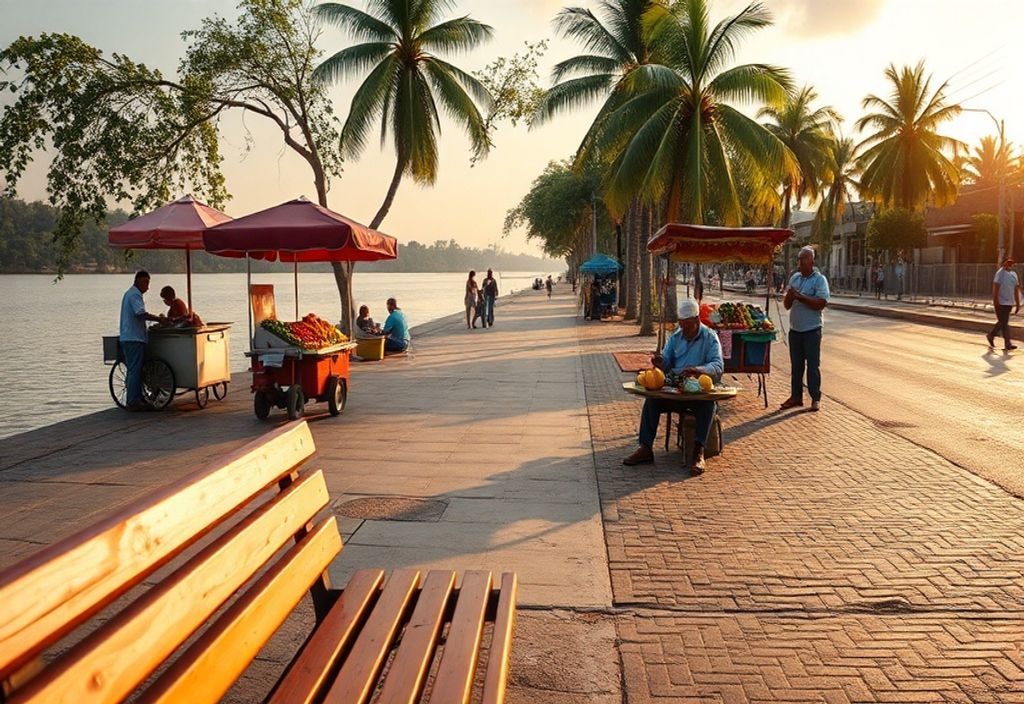
I wander along the Paseo Orinoco, a promenade by the Rio Orinoco. The famous river is wide here and muddy brown. I sit on a bench and watch the city wake up. Two guys are setting up their hot dog cart. The fruit vendor’s already open for business. The shoe repair guy arrives with two big bags, settles at his regular spot where he’s got a table set up, arranges his tools, opens his newspaper and reads while waiting for customers. Across the street, two more vendors are setting up their mobile stands.
At eight I head to the bank – they can’t exchange dollars yet because the official rate hasn’t been announced. Come back at ten. I kill time wandering through the center. Ciudad Bolívar is manageable – two main streets and some cross streets. Compared to the Brazilian cities, I really like this place. There’s a proper main plaza again with a cathedral and colonial buildings, lots of narrow alleys. The city has character. At ten I cash a hundred-dollar traveler’s check, check into my room – quite decent and clean – take a shower and finally crash for a few hours. In the afternoon I drop my filthy clothes at a laundry and mail ten postcards I’d already written. 30 Bolívars to send a card to Europe. The heat and humidity are noticeable here, but nowhere near as suffocating as Belém or Manaus. Over a drink I run into Burt again. We wander through town together. Evening comes and we grab dinner with a Swiss guy and a German I’ve crossed paths with several times on this trip. The four of us hit a grimy, dark bar – the only one still open at 10:30 PM that won’t break the bank. At midnight I call it quits – I’m beat and desperately need sleep.
A Trip to the Tepuis
Tuesday, June 9th
I sleep in gloriously until eleven. Much needed. After breakfast I bus out to the airport to see if I can make a collect call to the States. Curious how my people back in the US are doing. No luck – can’t do it from here. But some guy gives me solid intel about flights into Tepui country and to Salto Ángel – the world’s highest waterfall. Fascinating. Would be quite an adventure, but pricey. Maybe next year.
That evening I’m back at the restaurant with the Swiss and German guys. I’ve picked up a couple maps of the Tepui area, and as we’re talking, an idea takes shape: Why don’t we organize our own trip to the Falls? We’d need two more people to split the cost of chartering a plane. The German asks an English guy and a Canadian woman from his hotel. They’re interested if it doesn’t cost too much. Only one hitch: the German can only come if his money finally shows up tomorrow – he’s been waiting on it for days. We agree to meet at ten tomorrow to sort everything out.
Wednesday, June 10th, 30°C
Ten o’clock brings disappointment: the German’s money still hasn’t arrived. He’s out. Okay, just the four of us then. Luici, the Italian-Swiss guy, Jen the Canadian, John the Englishman, and me – we head to the airport to charter a plane for tomorrow. We shop around among the small airlines, they are mostly operating Cessnas. Everyone’s got the same prices: 5,000 Bolívars (roughly 80 bucks) round-trip to Canaima. Or 6,500 with a flyover of Angel Falls included. We book for tomorrow morning at seven to Canaima – no flyover. We’re supposed to show up at 6:30 AM. While Luici hits the doctor (ear problems), the three of us shop for the four-day trip: rice, some vegetables, spaghetti, beans, coffee – everything we need to be fairly self-sufficient. Jen buys a hammock and we grab plastic tarps for rain protection. Back in the Hotel we divvy up the supplies among the four of us. That evening I pack my essentials in the backpack and stash the rest in the hotel’s storage room. I also already book a room for Sunday when we get back. At 10 PM I’m in bed, buzzing with anticipation for tomorrow’s start of a hopefully exciting adventure.
The Flight to Canaima – Between Clouds and Worry
Thursday, June 11th
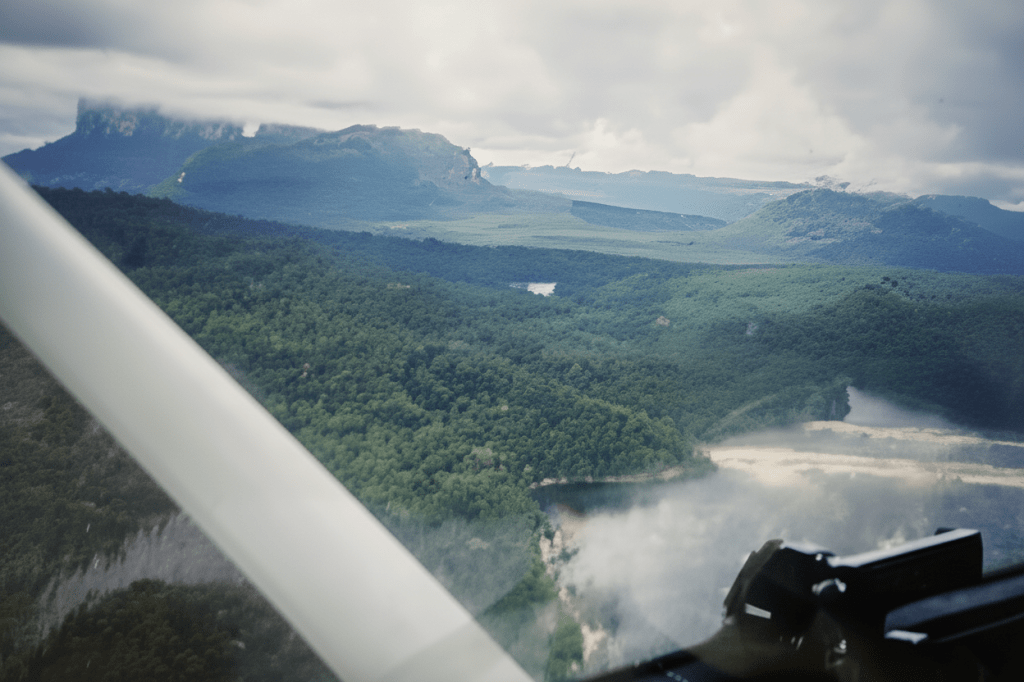
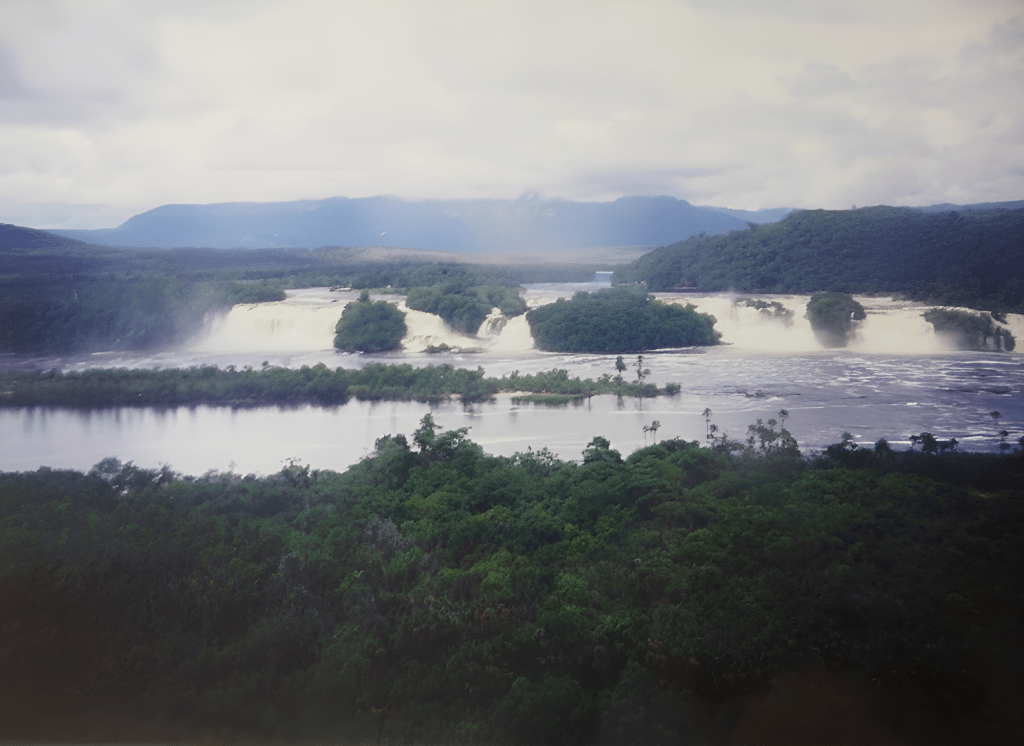
Up at six, check out and head to the others’ hotel with my gear. Taxi to the airport. We’re supposed to leave at seven. We grab coffee in the terminal and wolf down a quick breakfast. Then it starts raining. Damn. In rain and heavy cloud cover we can’t fly. Too risky. So we wait. Coffee after coffee. The clock ticks. This drags on until around eleven. John and Jen head to the bank – and naturally, five minutes after they leave, the plane’s ready to go. Another twenty minutes waiting for those two. Finally we’re off. We load our gear into the small plane and climb aboard. I’m up front next to the pilot. The engine roars to life and we’re airborne. Still cloudy, but we’re flying low enough to maintain decent visibility. We head south over previous rain-forest land, it burned years back – now just grassland remains, dotted with small patches of trees. The closer we get to Tepui country, the forest reapears. Eventually we’re flying over solid, untouched jungle. After about an hour the tiny village of Canaima comes into view. It sits on a small lake fed by five to seven waterfalls of varying sizes. The pilot takes us over a Tepui where several smaller falls drop from the plateau.
Oh, and the pilot mentions casually that half an hour ago a small plane went down at a nearby diamond mine. He makes a detour to fly over the crash site – he wants to see how bad it is. The plane lost control on the dirt strip during landing and the nose got plowed into the ground. Doesn’t look too serious – a few people are standing around the damaged aircraft and nobody appears hurt. Still – leaves us with an uneasy feeling about our own landing!

Welcome to Canaima
Landing went smooth. We grab our gear and head into the village. Back in Ciudad Bolívar at the airport I’d talked with a guy named Tom who runs tours to Angel Falls. I’d negotiated a decent price with him. He flew up two hours ahead of us and was supposed to wait here. We’re told he might be at the bar by the lake. No Tom, but he should be back soon. We wait. The scenery is breathtaking: the lake with waterfalls in the background, surrounded by lush tropical vegetation – it looks incredible!
The village itself is totally touristy, though – dominated by a big, expensive hotel with cabañas. After an hour one of Toms associates picks us up and leads us to his place on a peninsula near the falls. Tom and a German couple I’d chatted with at the airport are already there. Tom has built a simple tourist hut – thatched roof, waist-high walls, open on all sides. Very basic. He’s already strung up six hammocks for us. Now we hammer out the final price: 4,500 Bolívars per person for the Angel Falls trip, 500 for two nights in his hut, 1,000 for today’s excursion. Total: 6,000 Bolívars per person – about 100 bucks for four days. Sounds steep, but other operators charge way more. Booking direct from Ciudad Bolívar runs about 300 dollars for three days. We’re doing four days for 200, including the flight, food and everything else.
Behind the Waterfall
We gear up for an excursion to a nearby waterfall. Since it’s drizzling, we just wear swim trunks and T-shirts, cameras safely wrapped in plastic bags. Jen wants to save the 1,000 Bolívars and stays behind at the hut. We trek through jungle, up and down, until after about half an hour we reach a massive waterfall – maybe 20 meters high and 80 meters across. With the rainy season in full swing the river’s carrying serious water – looks spectacular. In the dry season, Tom says, it’s practically bone-dry. Then he leads us along a narrow trail he himself carved out years ago, right behind the curtain of water, to the other side. We get completely drenched by the spray. It’s an incredible sensation walking behind a thundering waterfall – spray hammering our faces, the roar deafening. On the far side Tom shows us a cave with some rustic furniture. He lived here for quite a while, a few years back, he tells us. We take a breather then climb up to the top of the falls. From there you can look straight down into the churning water below. We poke around the area for a bit then head back the same way. Back at camp we change into dry clothes and build a fire to cook dinner. Rice with vegetables. We eat and hit the hammocks. Tomorrow’s an early start.
To the Highest Waterfall in the World
Friday, June 12th
I was a bit cold last night, therefore slept very little and so I’m up at seven. I get a fire going for coffee. The others surface one by one. We eat breakfast and at 8:30 we boat from the Island across to Canaima. From there it’s about a twenty-minute walk to where the canoes launch. We wait for Tom but he’s a no-show. Instead there’s a woman and some younger guys helping us loading our gear into a long, narrow canoe and covering it with plastic. The woman – Gladis is her name – says Tom isn’t coming and she’s our designated guide now. She’s got another guy with her, probably her boyfriend. The three guys are also coming along, taking turns in steering the canoe.
Up-river Through the Wilderness
And we’re off, heading upriver in the loaded canoe, toward the Tepuis. The river starts out relatively calm, then gets progressively wilder. Sometimes we’re literally fighting through rapids, traveling through a huge valley, always upstream, the sheer Tepui walls rising on both sides – some nearly a thousand meters straight up, flat-topped like they’d been sliced off with a knife. The views of these imposing cliffs with jungle in the foreground are stunning. Waterfalls plunge everywhere from the mountains into pristine rainforest, feeding the major rivers.
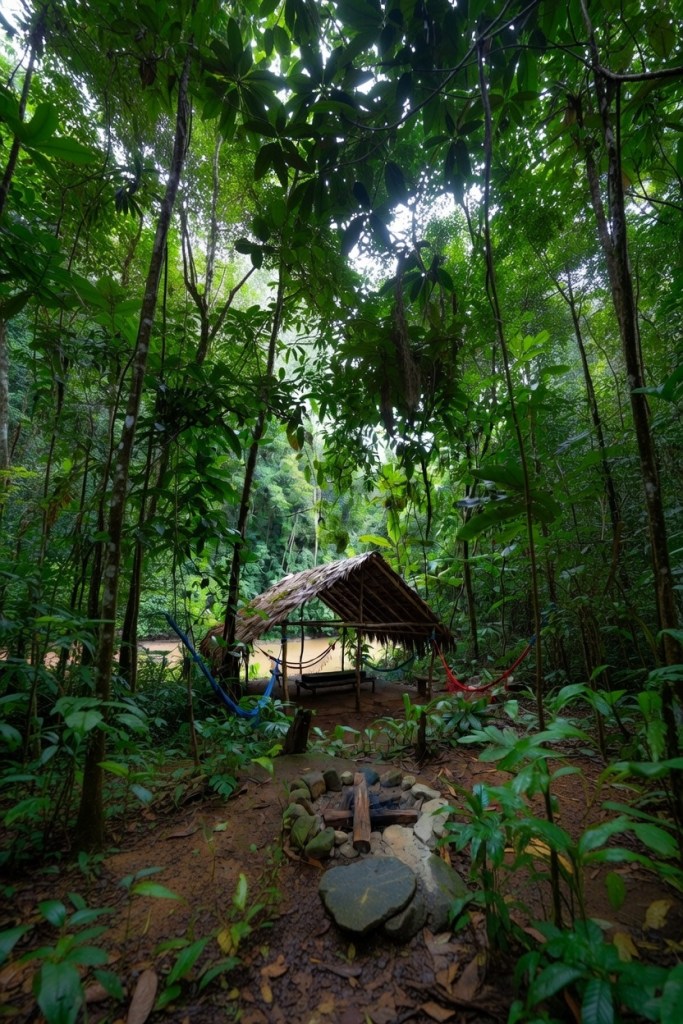
The water has this incredible reddish tint which comes from the roots of some local tree species. I’ve never seen anything like it. Looks amazing, especially where the water runs shallow and slides over rocks. At one point we squeeze between two massive boulders – barely enough room. One side of the canoe slams into rock. Nearly crushed my fingers. For a split second I think: We’re going over! But we make it through. My heart’s still pounding minutes later. After about five hours on the River we reach camp. We unload, hang our hammocks and chill for a bit. The camp’s just a simple shelter – posts supporting palm-leaf roofs with hooks for hammocks. No walls. A fire pit and an outhouse. We wash in the river.
The Moment of Awe
A little later we pack cameras and rain gear and set off on the forty-minute hike through rainforest to the Angel Falls. I have to give Gladis a bit of grief because she’s only paying attention to her boyfriend and basically ignoring us instead of working as a hired Guide. At first she gets annoyed, but then she starts pointing out local plants and telling us stories and myths about Angel Falls.
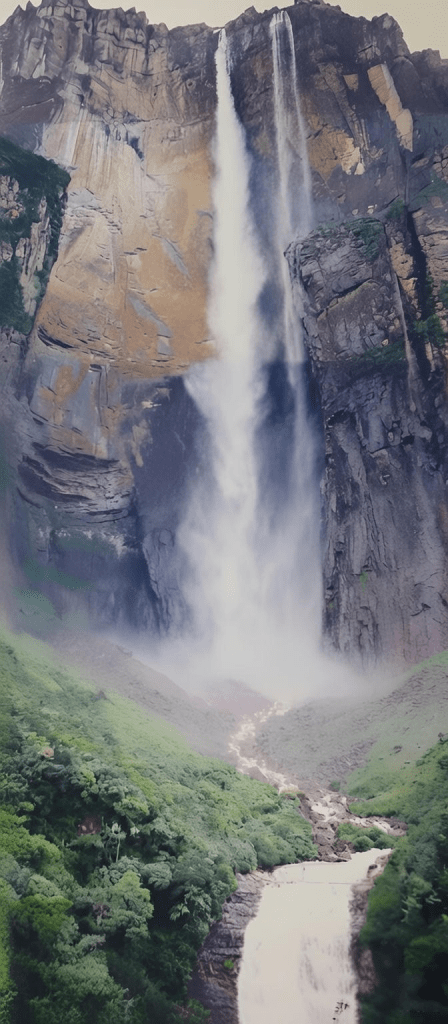
And then, suddenly, there it is. Right in front of us. The highest waterfall on the planet. A 997-meter free fall: water plunges from the Auyan-Tepui into the depths where we stand. We settle onto a rock about five hundred meters from the falls and just watch. The waterfall isn’t exceptionally wide – more like a thin ribbon of water leaping off the cliff, dropping down, hitting the bottom in a cloud of spray, then continuing as a river over smaller cascades. Total spectacle. With the tropical landscape all around, it’s simply breathtaking. Especially the wall rising steeply on both sides of the falls, carved out over millennia – a testament to water’s immense power. We sit for ages, shooting photos and just marveling.
Afterwards we climb down to a smaller waterfall for the others to swim in the pool below. I pass – the water’s too cold for me. Back at camp we cook dinner. Tonight’s menu? You guessed it – rice with vegetables. Everyone’s in their hammocks by 8 PM. Relaxing by candlelight as rain starts falling. We had great weather all day – only the Tepui peaks were wrapped in clouds as usual. I lie in my hammock and drift off to the sounds of the river and rain – a natural symphony better than any music.
The Return Journey – Between Relaxation and Terror
Saturday, June 13th
I dressed a lot warmer last night so I slept better. We build a fire, boil water for coffee and have bread with jam for breakfast. Then we stay around camp until about ten, exploring the area a bit. Around ten we load the canoe and head downriver back toward Canaima. Halfway back we make a two-hour stop at a waterfall with a swimming hole. The water’s warmer here so even I can get in. We reach Canaima around 5 PM. We say our goodbyes to the guides and helpers, head down to the lakeside bar in the village and knock back a well-deserved beer. Later we catch a ride to Toms hut, cook dinner and turn in early again.
Sunday, June 14th
We kill time until our flight in and around Canaima – hit the beach by the lake, lounge in hammocks, wait for our plane that’s supposed to arrive at 3 PM. The German couple already flew back to Ciudad Bolívar early this afternoon.
The Flight from Hell
At quarter to three we head to the airstrip and wait for our plane. No show. We wait. At 4:30 a small Cessna finally approaches the runway. That’s us. The pilot – different guy from three days ago – climbs out. He’s totally nervous and tries to secure the rear seats that are sliding around on their rails. Can’t get them fixed. Cursing under his breath. I ask what’s wrong and why he’s in such a rush. “A buddy of mine just crashed,” he says. “I need to get to La Paragua village ASAP.” What? Another crash already? Seems to be routine around here. Not exactly reassuring. Especially with the pilot this rattled. Finally he gives up on the seats. John and I take the two loose seats. Seat belts are pointless – if we crash we’re flying through the cabin with the seats anyway. We try to stay positive, muster our courage. Here we go. Takeoff goes fine, except there’s this weird banging and clattering on my side of the plane. The pilot glances back, hears it, curses and brings us down for another landing on the strip we just took off from. Once we’re stopped he says: “Open the door and pull the seat belt inside.” So that was the racket – the belt was hanging out of the Door, banging against the fuselage. Take off again. North toward La Paragua. The pilot chain-smokes, tossing butts on the floor and then frantically stomping them out – in a plane full of fuel fumes! I’m sweating bullets! Landing in La Paragua in the rain. Refueling stop. Then on to Ciudad Bolívar. The landing goes smoothly.
We made it. I ask a few people standing around about the crash. One dead, some injured. Shit. The thought settles in slowly: this could just as easily have been us. I guess we were lucky. We head downtown by taxi to the hotel, take a hot shower, and later sit down for dinner together, talking over the trip and the road ahead.
Epilogue
That was my Gran Sabana adventure. A trip that had everything: stunning nature, cultural encounters, spontaneous intimacy, adrenaline rushes, and constant reminders of life’s fragility. But Angel Falls, the Tepuis, the color of that water, the feeling of walking behind a waterfall – unforgettable.
Today the four of us – John, Jen, Luici and I – are heading to the coast, to Puerto La Cruz. The story continues – this time with an spontaneous sailing trip through the Caribbean waters off Venezuela’s coast.
Stay tuned.
This is an excerpt from my diary of a journey that took place in 1992, when Venezuela was a different country – more open, accessible, full of adventure for backpackers. The memories remain, even though the world has changed.
 driftingvagabond.com