Let’s take a closer look at power for a minute — not the glossy, endless-sunshine version of vanlife, but the real, rain-soaked, everyday kind.
I’ve been on the road for months now, including what turned out to be the wettest winter Spain has seen in years. Long grey stretches. Days of steady rain. Very little solar yield. And yet, I haven’t plugged into external power once.
Not because I’m trying to prove a point. Not because I enjoy making life harder than it needs to be. Simply because, with the right setup and a bit of awareness, I don’t have to.
The Setup
My system is straightforward:
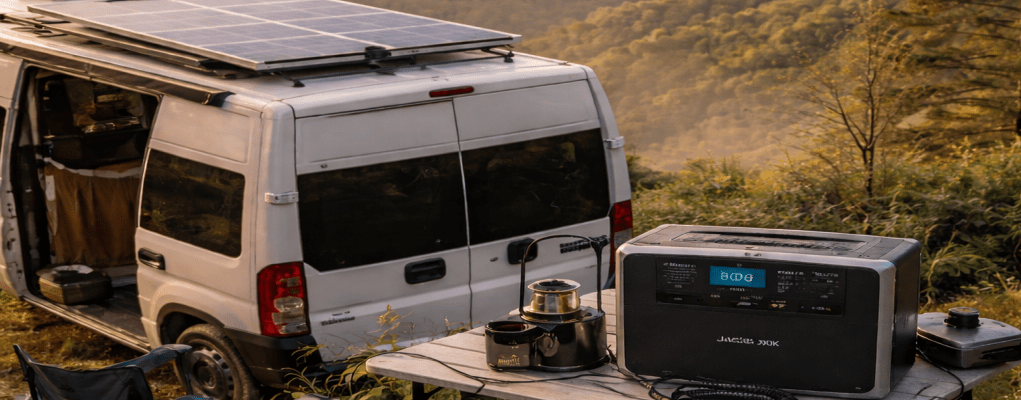
- 470 watts of solar on the roof
- A Bluetti AC200P as my main power source
- A Jackery Explorer 500 as a backup
- A Bluetti Charger 1 delivering up to 580 watts while I’m driving
There’s no permanently installed lithium bank hidden behind panels, no complex inverter wiring, and no monitoring system that needs constant attention. Just portable units that do what they’re supposed to do, reliably and without drama.
Why Driving Matters More Than Sun in Winter
Solar works beautifully in summer. In winter, especially during long rainy periods, it becomes unpredictable.
That’s where the real advantage of this setup comes in.
If my main battery drops low and the forecast looks grim, I simply drive for a couple of hours. During that time, the DC-DC charger feeds serious power into the system. By the time I arrive at the next location, the battery is usually charged enough to give me another two or three comfortable days.
That ability to turn movement into stored energy changes everything. It removes the dependency on perfect weather and replaces it with flexibility.
Where the Power Actually Goes
In reality, my consumption is modest. The main draws are the fridge and the laptop. Phone, lights, little bits and pieces — they barely register compared to those two That’s it.
When solar input drops for several days, I don’t panic — I adjust.
At night, I switch the fridge off. The ambient temperature is low anyway, and the fridge is well insulated, so it doesn’t warm up dramatically in a few hours. If conditions stay poor, I run it more intentionally: cooling it down properly, switching it off, and turning it back on once the temperature rises again.
Inside the small freezer compartment, I keep two water bottles frozen solid. When the fridge is off, they act as additional cooling mass, slowing down the temperature rise. It’s simple physics, not technology — and it works remarkably well.
At the same time, I reduce unnecessary consumption. Laptop and phone go into power-saving mode, screen brightness comes down, background processes are limited. And when energy is tight, I skip the coffee machine and heat water on the gas stove instead.
It’s not about deprivation. It’s about paying attention.
Using the Backup Strategically
If my main battery drops to around fifty percent and the weather forecast suggests more grey days ahead, I shift the fridge to the smaller unit — the Jackery. But even then, I run it selectively and avoid powering anything else from it.
Used this way, the smaller station lasts surprisingly long. Especially when the fridge isn’t allowed to cycle endlessly without purpose.
The Reality of “Unlimited” Off-Grid
Can I stay off-grid indefinitely?
In practical terms, almost.
As long as I manage consumption, stay mobile when necessary, and remain flexible, I can live for a very long time without ever needing to plug in.
But here’s what often gets overlooked: it works because I adapt.
Off-grid living isn’t primarily about massive battery banks or impressive solar numbers. It’s about understanding your actual needs and being willing to adjust your behavior when conditions change.
If you expect apartment-level energy use inside a van during a rainy winter, you’ll struggle. If you’re willing to make small, sensible adjustments, you’ll realize how little electricity you truly need.
The goal isn’t unlimited power.
It’s independence from the socket.
And once you reach that point, the freedom feels surprisingly quiet — and very real. ⚡🚐
 driftingvagabond.com