A Journey Beyond the Last Airstrip
We arrived in Misahuallí on September 22. We were not seasoned explorers. We were not survival experts. We were five young men drifting through South America with more time than plans, convinced that the Ecuadorian Amazon was a perfectly sensible next step.
Misahuallí was the kind of frontier town that pretended to be organized but really ran on negotiation and patience. The main street was full of tour offices that all promised adventure in exchange for money we didn’t really want to spend. Every conversation began with enthusiasm and ended with a price that sounded outrageous to us.
Fifteen to twenty-five dollars per day per person.
We nodded politely, then stepped outside and calculated how long we could survive on rice and beer for that amount of money.
There was also the small detail that entering certain jungle regions required permission from the military. Because apparently you couldn’t just wander into the Amazon like it was a botanical garden.
One organizer, Henry, offered an eight-day tour from Coca. Boats. Jungle trekking. Indigenous villages. It sounded perfect. The only issue was that he didn’t yet have the military approval. But maybe tomorrow. Or the day after. Or soon he said.
We waited, played billiards for hours. We lost a card game to two Germans and paid for their beers. We spent evenings in a Peña bar and mornings calculating exchange rates.
The jungle was still theoretical.
After two days of bureaucratic limbo, we decided to move on to Shell-Mera, where small missionary aircraft flew deep into the interior. If the system wouldn’t let us in through the front door, we would try the side entrance.
Miraculously, it worked.
We found a missionary aviation company willing to fly all five of us to Cural for 43,300 sucres — roughly seventy-five US dollars. It felt like we had cracked the system.
Of course we still needed a military permit for the mission flight because technically they weren’t supposed to transport civilians commercially. So we spent half a day in military offices waiting, sweating, being told to come back later, and eventually receiving the necessary stamps.
Victory.
The day before the flight we traveled to Puyo to buy supplies. We spent hours walking through dusty streets gathering everything we thought we might need to survive in the Amazon: rice, spaghetti, tuna cans, peppers, coffee. Manu, Franz, and Peter had left most of their equipment in Quito because they had originally planned only a coastal detour before impulsively joining our jungle ambition. So they purchased rubber boots, plastic rain covers, mosquito spray etc. By evening we were loaded with provisions and confidence.
But confidence lasted exactly until weigh-in.
On the morning of departure, the pilot calmly informed us that the aircraft could carry 400 kilograms total payload. We — including luggage — weighed 483.
There was that moment where nobody spoke. Eighty-three kilograms of misplaced optimism.
The pilot refused to fly overweight, which in hindsight I appreciated deeply.
There was discussion of chartering a separate aircraft for Peter, who carried the statistical burden of being the heaviest among us. A flight school instructor briefly offered to take him for 30,000 sucres, but authorization from his superior was denied. Prices shifted upward. Time stretched. Frustration built.
It became clear that physics and hierarchy were equally inflexible.
Eventually Peter made the decision easier for all of us. He would follow later.
So four of us climbed into the tiny aircraft, wedged between backpacks and calculations, and the plane lifted off.
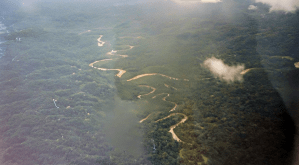
The takeoff was surprisingly smooth. As the plane climbed to roughly 300 meters, the landscape below shifted from patchwork deforestation to rolling foothills — the last fingers of the Andes — and then, gradually, to uninterrupted green. Endless forest. No roads. No fields. No geometry. Just canopy.
After about forty minutes, a narrow grass strip appeared, carved into the jungle: Cural.
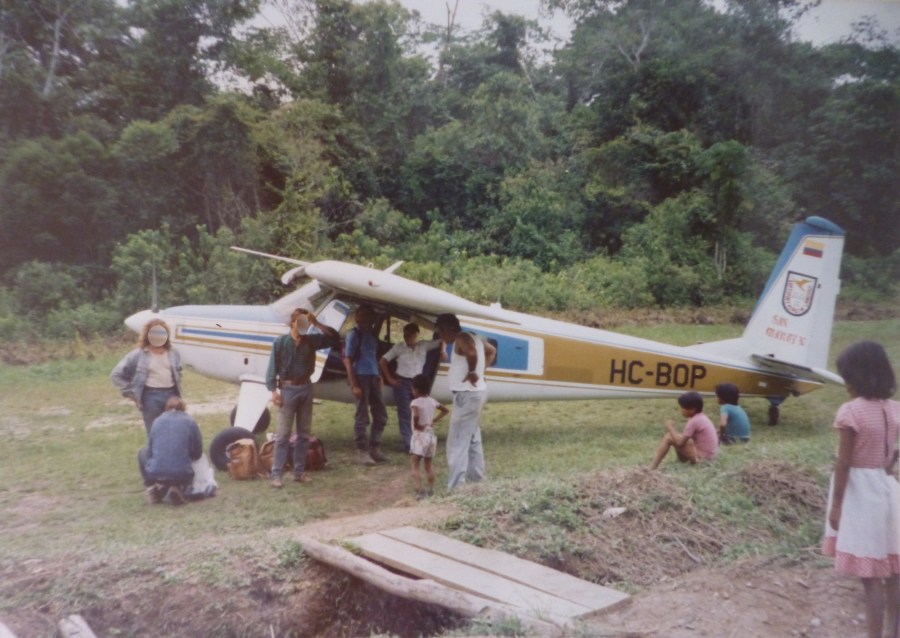
We landed hard, bounced once, and rolled to a stop. A handful of villagers stood waiting. Among them was Danilo our guide. He was calm in the way of someone who did not need to prove competence.
We unloaded our gear and followed him to his canoe. His house stood on wooden stilts about fifty meters from the brown river. It was simple but solid, with a wide open terrace. The river flowed fast and opaque.
A doctor at the airstrip had warned us not to swim in it — Parasites, Bilharzia, unseen life with microscopic ambitions. We nodded responsibly.
Peter arrived the next day after rain delayed his flight. We celebrated his arrival with optimism and unsuccessful fishing attempts. That evening we cooked spaghetti with peppers over open fire in Danilo’s kitchen while rain hammered down in dense tropical sheets. The jungle did not introduce itself gently; it soaked us thoroughly first.
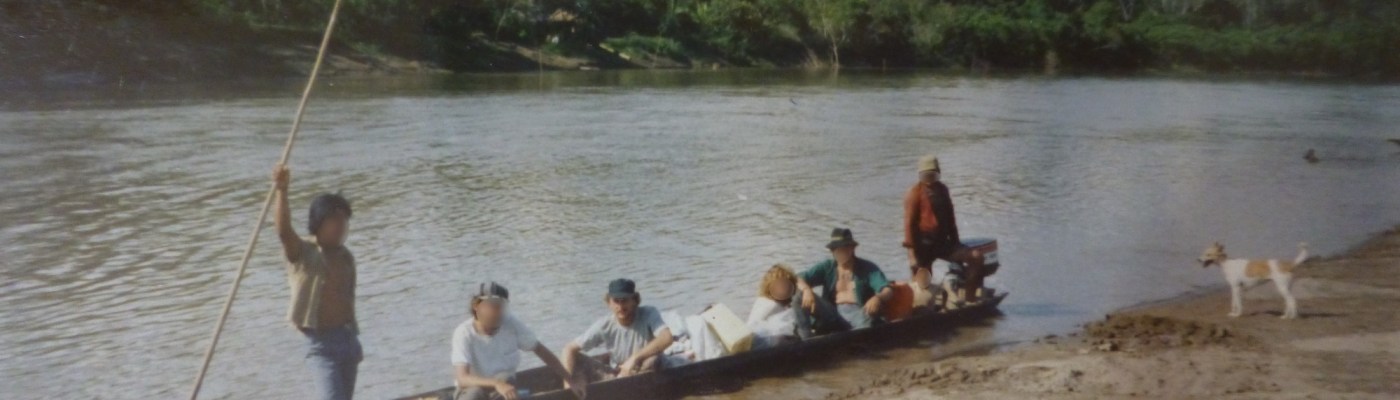
Two days later we were finally ready to leave Cural for the deeper interior. We loaded a long dugout canoe with food, fuel, machetes, a shotgun, ammunition, mosquito nets, and the five of us, who at that moment still believed we understood what we were doing.
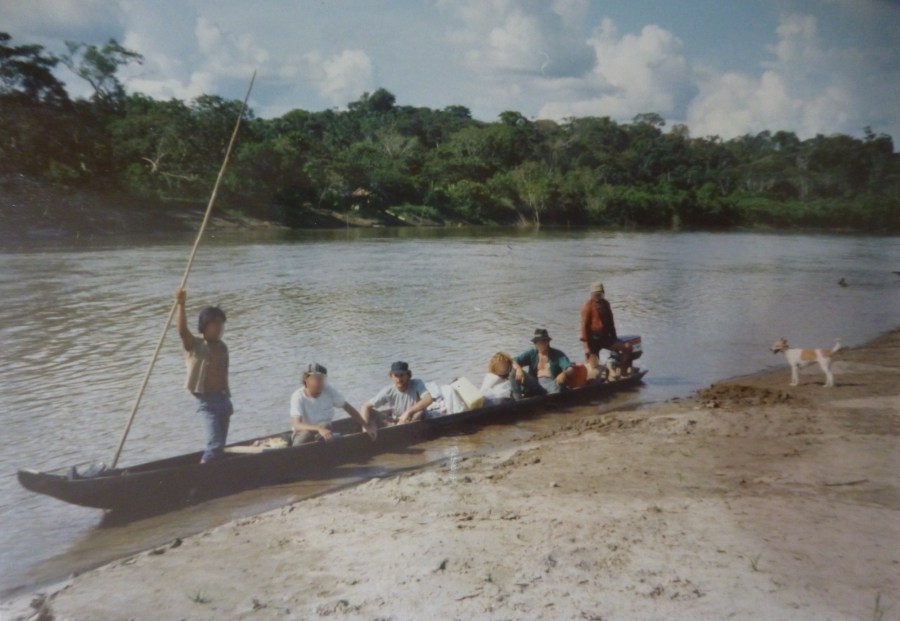
We drifted downstream and left the last houses behind. The river was broad, brown, muscular. Turtles slipped from sunlit logs into the current as we passed. Parrots and scarlet macaws crossed overhead in pairs, their colors violently bright against the sky. Toucans watched us from branches, their oversized beaks giving them a permanent look of theatrical importance.
Rain arrived suddenly, as it does in the tropics. Heavy, warm, unapologetic. Peter, Manu, and Franz wore improvised raincoats fashioned from plastic tarps purchased in Puyo. They looked like determined shipping parcels. We laughed, then realized the improvisation was effective.
At one point Danilo cut the motor and drifted toward the bank, raising his shotgun slowly. A bird sat in the canopy — a pava, likely a Spix’s Guan, a large arboreal bird resembling a slim jungle turkey with dark plumage and a long tail designed for balance among branches. One shot echoed across the river. The bird fell.
Daua, our second guide — a quiet, efficient man with a hunter’s instincts — cleaned it within minutes. The jungle did not indulge sentimentality. Food was food.
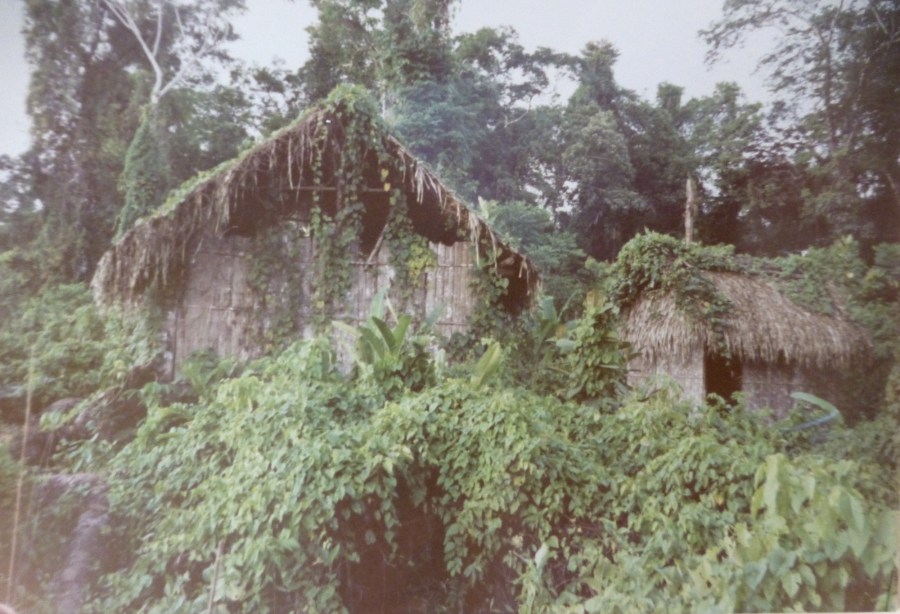
After six hours on the river we reached a wooden hut built months earlier by a German who had intended to develop tourism there. It had since been abandoned and partially reclaimed by vegetation. We cleared vines, swept out debris, and declared it home.
 Fishing with the bird’s entrails as bait produced catfish almost immediately. Later, in a nearby lagoon, we caught piranhas whose teeth looked exaggerated, almost cartoonishly dangerous, yet entirely real. The lagoon itself was breathtaking — still water reflecting sky and forest so perfectly that orientation became uncertain. It was wilderness without framing.
At night we returned to the lagoon to observe caimans. We paddled quietly for nearly two hours without a motor, listening to bats skim the water’s surface. When darkness fully settled, we shone our flashlights across the lagoon. Red reflections flared everywhere — dozens of eyes hovering just above the surface.
We had planned only to observe.
But proximity changed intention.
One caiman floated close enough to feel unreal. Daua moved before we fully processed what was happening. The spear, attached to a rope, flew. It struck. The water detonated into chaos. The canoe rocked violently as the animal thrashed, its tail slamming against wood. Within seconds Daua delivered machete blows to the skull and hauled the body in. It measured roughly 1.5 meters. Small, technically. Not small in context.
The next morning we ate crocodile soup for breakfast. The meat tasted surprisingly delicate, somewhere between fish and firm poultry.
On October 1st, we entered the forest on foot. Long sleeves, boots, machetes, mosquito spray. Contrary to cliché, the jungle interior was not an impenetrable wall but a cathedral of tall trunks with filtered light. The path was invisible unless you knew how to read broken stems and subtle disturbances.
We tracked wild boar. Danilo and Daua disappeared ahead. Gunshots echoed faintly. When they returned, each carried an animal across his back as if it were merely a large backpack. They cleaned the carcasses in a small creek containing — according to Danilo — piranhas. I asked whether the blood might attract them aggressively. He shrugged and assured me nothing would happen. That reassurance had become standard operating procedure.
Back at camp we grilled our portions of meat over open fire. The guides boiled theirs in soup, insisting that boiling was safer. We listened respectfully and continued grilling. The meat was excellent. Danilo smoked the remaining strips over the fire to preserve them for transport home.
 Only later did the strategic elegance of the situation reveal itself: Danilo’s name-day was approaching, and our expedition had conveniently secured substantial fresh meat for the celebration. Hunting near the village was no longer productive. Deep jungle was.
Returning to Cural felt almost busy after days of isolation. Word of the celebration spread quickly. Men gathered separately from women. Cassette music played. Chicha — fermented yucca drink — circulated continuously in metal cups. More and more villagers arrived, including Huaorani families who spoke no Spanish. Some of the girls wore faint facial paint. Clay figurines were sold. Conversations unfolded in fragments of shared vocabulary.
Danilo stood in the center, calm and composed, quietly orchestrating hospitality. Wild boar with rice and onions was served. Crocodile reappeared. Cups were refilled. I contributed a bottle of schnapps to intensify the chicha, a decision that seemed generous at the time and questionable later.
I was enthusiastically pouring refills for half the village, but it got to the point where I just had too much and passed out right there on the Terrace floor.
I woke around one in the morning. The music was still playing. A few loyal drinkers remained. The jungle had once again provided education.
The following morning there was no dramatic hangover, only a faint internal reminder of excess. We waited again for aircraft confirmation. The grass airstrip doubled as pasture for domestic animals and had to be cleared manually before landing. When the small plane finally appeared overhead, villagers gathered to watch.
This time we were light enough for all five to fly together. We all had lost a few kilos in the last days, supplies had been consumed or gifted. We loaded the aircraft carefully for balance, luggage on laps. The cabin was cramped beyond comfort. Turbulence felt magnified. For forty-five minutes I concentrated intensely on not throwing up while the endless green rolled beneath us.
Then the green canopy fractured.
Shell-Mera reappeared as if the jungle had simply allowed us temporary access.
We retrieved our passports from the military office, boarded a bus — on the roof, naturally — and continued toward Baños. The Amazon closed behind us, seamless and indifferent.
There was no visible evidence that we had ever been there.
But we carried it with us — the river’s current, the red glow of eyes on black water, the weight of wild boar across human shoulders, the taste of crocodile soup at dawn, and the quiet realization that the jungle operated on its own terms.
And for a brief moment in 1989, it had tolerated ours.

