From the streets of Lima to Machu Picchu — with uncertainty never far away.
When I landed in Lima, it didn’t feel like arriving in a new country — but more like stumbling into a different reality.
Just a few hours earlier I had been in clean, polished, orderly, controlled Miami.
This view from the airplane window: an endless sea of dusty, patched-together houses stretching all the way to the horizon. Grey, chaotic, somehow hopeless — and at the same time utterly fascinating.
At the airport, everything moved surprisingly quickly. Immigration: a stamp, 90 days, a few dollars exchanged — and suddenly I was a millionaire. Millions of Intis.
Outside, it started immediately — screams from all sides:
“Taxi! Taxi! Taxi!”
Voices, hands, offers from every direction. I tried to stay calm. Eventually I agreed on a deal — four million Intis for a ride into the city center. Two guys stuffed me into a battered VW van, and off we went.
The ride was my second impression of Lima — crumbling buildings, garbage, dusty streets, people everywhere. It was loud, raw, unfiltered.
The first hotel we stopped at was full. Of course.
So on to the next. Another taxi, another attempt, until I finally landed in a simple hotel. Nothing special — but it had a rooftop terrace. And that terrace became the center of my stay for the next few days.
It was the kind of place where travelers from all over the world end up: Austrians who had spent months in Chile, a Canadian named Bob who would become my travel companion for the coming weeks, Finnish women, New Zealanders.
On that terrace I met a Swiss woman who had already been in Lima for weeks and had no intention of moving on. While I was still trying to make sense of everything, she had long since decided she liked it right here in this city.
We went out to eat together, ran into a German from the hotel, talked for hours. One of those typical evenings where you don’t really know each other at all, but somehow you’re immediately on the same wavelength.
The next day I set out to explore the city. Much of it felt interchangeable — large plazas, heavy traffic, crowds of people.
Back at the hotel, life shifted again to the terrace.
Australians, Germans, South Africans — a colorful mix of people who had all ended up here for the same reason: to check out Latin America. Stories were shared, plans were made, only to be thrown out the window the next day, after a few too many beers were drunk.
Lima was slowly starting to feel less foreign.
And yet the city had its dark side. On the way to the bus — I’m counting out money for the fare — some guy snatches the bills from my hand and takes off running. I chase him. He drops the money and keeps running, I reach down to grab it, stumble, fall. Get up, keep running. The guy is lightning fast — he scales a garage gate and vanishes onto a roof. I don’t catch him.
That bastard — it’s not even nine in the morning and I already have to chase damned thieves.
In 1991, Peru is not an easy country to travel though. Sendero Luminoso — the Shining Path, a Maoist guerrilla organization — is holding the country in a grip of fear. Bombings, assassinations, massacres in the mountain regions. Police and military stand guard in front of government buildings and factories. Yesterday, a 20-kilogram car bomb had exploded at the airport — one dead, eight injured. There are areas in the highlands that tourists are advised to avoid.
And something else — something I didn’t know when I arrived: Peru was in the opening days of one of the worst epidemics in its history. In late January 1991, the first cases of cholera broke out simultaneously in the Pacific port cities of the north — Chancay, Chimbote, Piura. The disease had spared Latin America for over a hundred years. Now it was back. The cause: a devastating combination of crumbling water and sewage infrastructure, and overcrowded slums.
The epidemic was a main topic of conversation — a fear, an invisible threat. When I arrived in Lima, the cholera hadn’t quite reached the city yet. But it was on its way.
And so was I — roughly two weeks ahead of it, maybe less. It was enough to keep a nagging unease in the back of my mind, and enough to speed up my decision.
I wanted to move on. South, then into the mountains and out of the country before something caught up with me that I couldn’t control.
Suddenly it was clear that this wasn’t just adventure anymore.
I decided to head south without delay. Terrorism and cholera in the north — that was enough for me to move on.
The journey south passed through a landscape that felt almost surreal. Beyond Lima, everything emptied out. The houses disappeared, the colors too. What remained was an endless stone desert stretching along the Pacific coast for hours on end.
Until eventually Nazca appeared — a place that looked unremarkable at first glance, but harbors one of the greatest archaeological mysteries in the world.
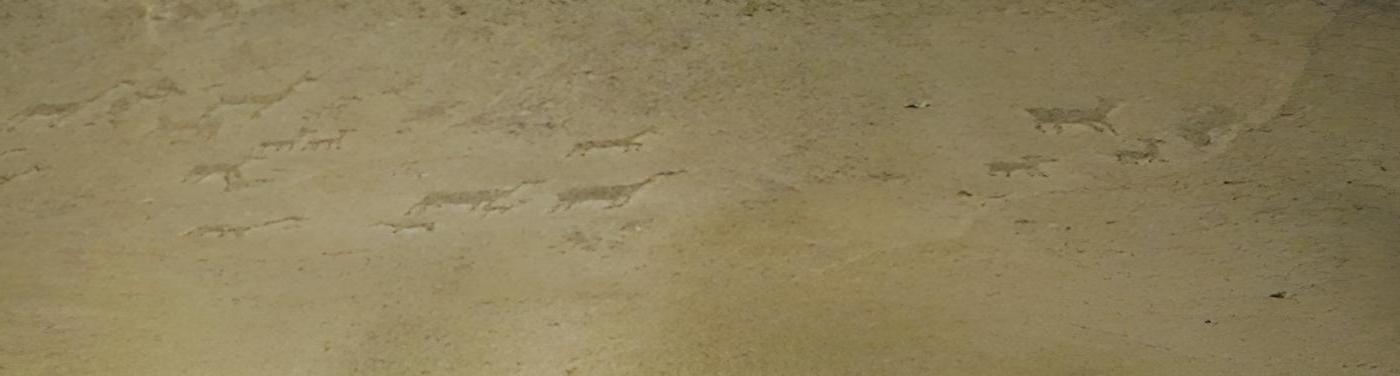
The famous Nazca Lines: enormous geoglyphs etched into the desert floor over 1,500 years ago. Lines, spirals, animals — a hummingbird, a monkey, a spider — stretching for kilometers and only fully visible from the air. To this day, no one fully understands why they were created. An astronomical calendar? Religious rituals? Something else entirely?
I didn’t see them from the air — a flight was too expensive for me.
But they weren’t entirely invisible. Along the route, you could make out figures on certain hillsides: clear lines, shapes that stood out sharply against the rock. Simpler than the larger motifs, but enough to understand that something completely unlike anything else had happened here.
And then there was something else — almost more striking, and considerably more unsettling.
An ancient Nazca cemetery.
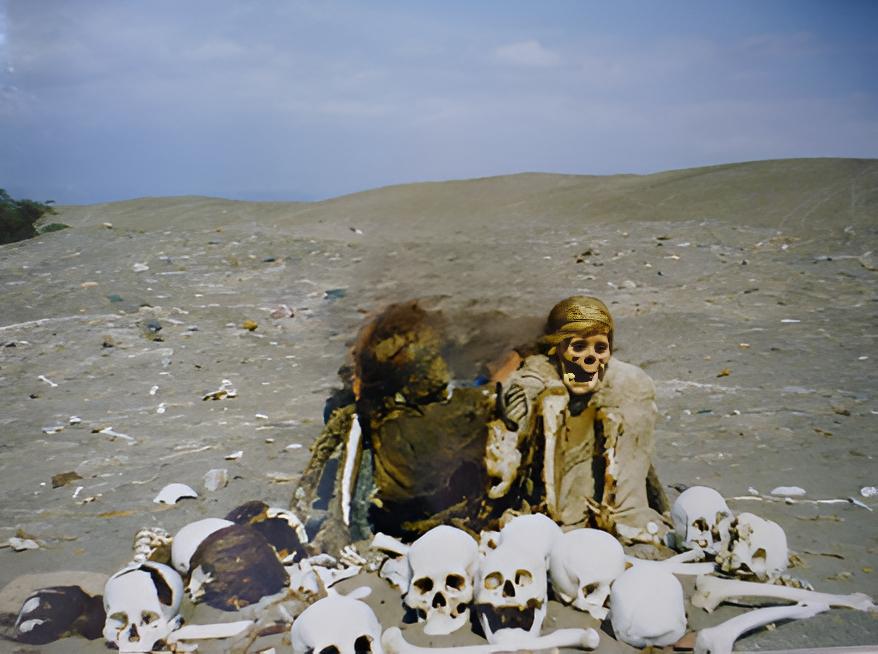
Bones, skulls, and scraps of fabric everywhere. Partly exposed graves, some looted, some half-open, as if someone had been digging there just recently. Mummies simply lying on the ground — with hair, ears, skin, some even with still recognizable facial features.
Our driver digs up a large clay bowl from the earth — someone had probably been digging here just the night before and hadn’t finished clearing the grave. History quite literally lying on the ground. Bones scattered over centuries by grave robbers and half-finished excavations.
From the coastal desert, the journey climbed steadily into the Andes.
Arequipa: The White City
Arequipa sits at 2,324 meters, framed by three volcanoes: El Misti, Chachani, and Pichu Pichu. The city is called the “White City” because many of its colonial buildings were constructed from sillar — a pale, porous volcanic stone from the surrounding volcanoes. The architecture carries a baroque elegance that seems almost out of place against the rugged highlands.
You sense immediately that you’re in the Andes — the air is thinner, the nights cooler, everything moves at a slower pace.
From there, I was drawn into one of the most impressive landscapes of the entire trip: The Colca Canyon.
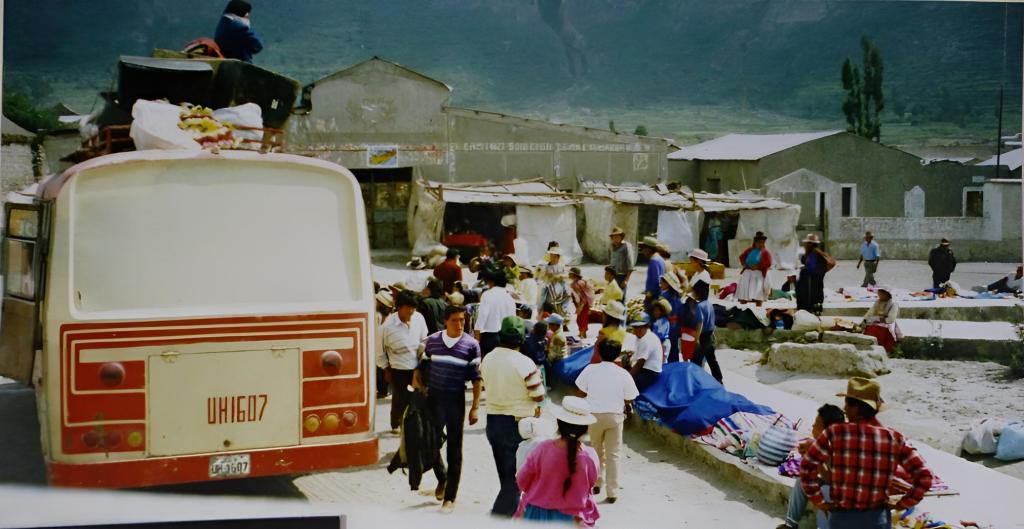
Six hours on a dirt road. The drive itself was already an experience. Endless switchbacks, altitudes topping 4,800 meters. The scenery shifted from dry desert to barren highland steppe and then into green valleys. Llamas and vicuñas grazing along the roadside, small villages where time seemed to have stopped — where traditions were visibly, actively lived. Carnival Festivals on the village squares, with music, colorful costumes, and dances that felt simultaneously foreign and incredibly alive.
What struck me most, though, were the terraced fields — built by the Inca centuries ago and still in use today.
We arrived in Chivay, a village with a predominantly indigenous population. Checked into the only hotel, rested a bit, then headed to the corner bar for a few beers and a couple of rounds of pool.
I could feel the altitude in the beer right away.
The next day we continued via Maca toward the Colca Canyon.
A truck took us as far as the road went — to the point where the river had washed it away. From there, the only way forward was on foot. Barefoot through an ice-cold river, then two and a half hours to the Cruz del Condor Lookout. Spectacular views down into the valley and across to the six-thousand-meter peaks on the far side of the canyon. At the viewpoint, the canyon opens up to its full depth: over 1,200 meters of sheer cliff face, the river at the bottom barely visible as a thin silver thread.
And then: condors. At first just tiny dark specks far below in the valley. Then closer. The birds glide — without a single wingbeat — up out of the canyon on thermal columns, soaring like living machines.
We kept going, another three or four hours to Cabanaconde, a small indigenous village.
We had planned to take a bus back to Arequipa via Huambo the next day. But in Huambo the road was flooded as well, meaning no buses were running. Which meant we had to walk back the same way we came. Five hours back to the river.
Back in Maca — where the village had been celebrating Carnival for days — we stayed for a while, watching the locals celebrate.
At 6:30 the next morning, we set off back toward Arequipa.
Finally, after five days, a hot shower. I smelled worse than I ever had in my life. The warm water was the finest thing I had felt in days.
At 9 p.m. we boarded a train again. Destination: Cusco. It was packed, and in our car there were even people lying on the floor. It departed at 1 a.m.
Ten minutes in, it stopped — locomotive failure. The locomotive was swapped out, and at 2 a.m. we were moving again.
Several people had warned us that theft was rampant on the trains from Arequipa to Cusco. So one of us stayed awake at all times to keep watch. Around 6:30 in the evening we reached the highest point of the journey — approximately 4,200 meters. Another hour’s wait. It was already getting dark.
A few hours later, we stopped at a town called Juliaca. The passengers in our car were visibly on edge. This was supposed to be a particularly dangerous place — people were known to board here specifically to steal. The train pulled in and people began climbing on. Bob and David blocked the doors at both ends of our car from the inside, so no one could get in or out. For about fifteen minutes the car was quiet. The people who had boarded — mostly young guys, almost certainly thieves — wanted to get off. We let them out, but didn’t let anyone else in. When the train started moving again, every single person who had gotten on had disappeared. They had come for one reason only. As far as we could tell, no one in our car lost anything. Except earlier that afternoon at another stop, where a woman had had a bag stolen — camera and all.
Around 1 a.m., we pulled into Cusco. Twenty-eight hours after we had set off.
Cusco is nothing like Lima. Three thousand years of history are embedded in every cobblestone. The Plaza de Armas is ringed by baroque colonial churches — and if you look closely enough, you can see the perfect Inca stonework beneath their foundations.
Cusco is also expensive, and the weather is miserable — often rainy and cold. Twenty-five degrees during the day, dropping to ten or fifteen in the evening.
From the highland capital, the journey continued deeper into the mountains.
On to the next train — to Aguas Calientes, the gateway to Machu Picchu.
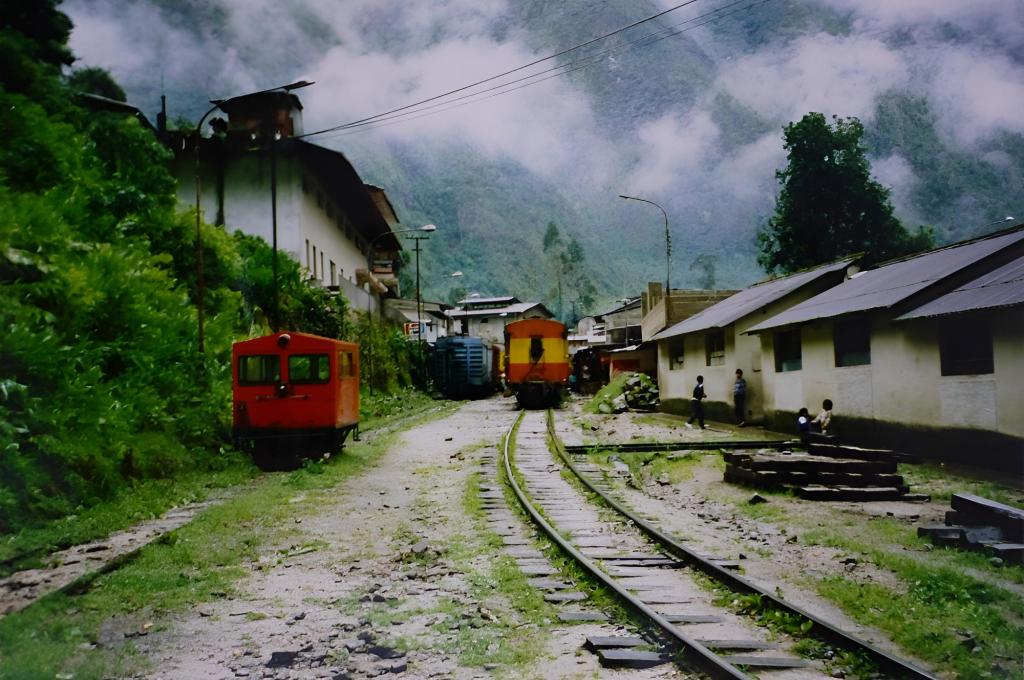
Tourist prices here in Cusco are outrageous, including train tickets. The official price for the ticket was 15 million Intis. We got them under the table for 4 million — the local rate.
About two hours into the journey, the train suddenly stopped and everything erupted into chaos. Someone had fallen from the train, I was told. People rushed toward the scene. He was dead, apparently — a boy who had been fooling around on the platform between two cars with some others had fallen. The things that happen here are hard to believe. Two hours of waiting. Then we moved on. Eight hours later, we arrived in Aguas Calientes.
The train runs literally through the middle of the village. On both sides of the tracks: restaurants with terraces, a small market.
Machu Picchu: “The Old Mountain” in Quechua, the indigenous language. Roughly 2,430 meters above sea level.
Seven o’clock in the morning. We set off on foot – about fifteen minutes along the tracks, where we got on a small bus to the ruins. A twisty twenty-minute drive to the entrance. Ten dollars admission.
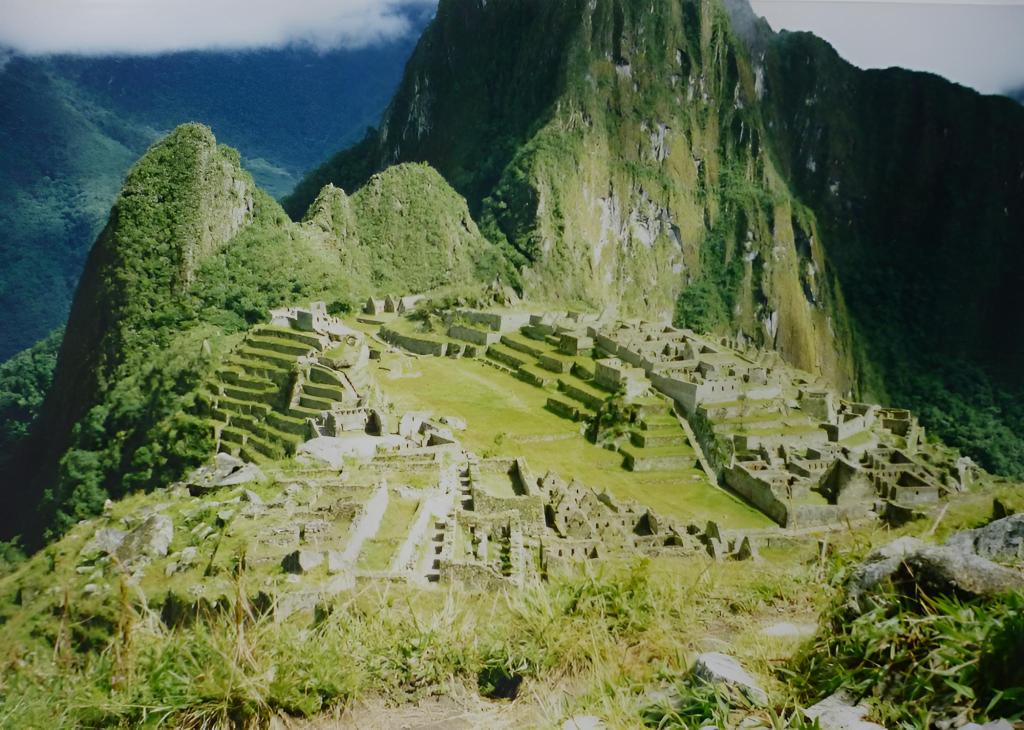
The “Lost City of the Inca,” surrounded by steep, green peaks and often shrouded in mist.
Standing up there by the Guard’s House, overlooking the whole area, I understood why this place has the reputation it does.
It’s not just the architecture, not just the setting — it’s the combination of everything. The way the ruins fit into the landscape, as if they were never truly abandoned. The terraces, the temples, the pathways — and above all, the feeling.
When the clouds roll in and slowly pull apart again, everything changes within minutes. Light and shadow move across the empty ruins, and suddenly the place feels alive again.
It’s easy to picture people having lived here once.
And at the same time it feels as if time has stopped entirely.
What the Inca achieved here is almost incomprehensible. On a steep mountain ridge, surrounded by jungle gorges, they built a complete city: streets, water supply, drainage systems, temples, residential quarters for priests and nobility, agricultural terraces.
The exact purpose of the city remains unclear to this day. When the empire collapsed, knowledge of Machu Picchu was slowly erased from history.
These are the most impressive ruins I have ever seen. Without question.
The train back to Cusco. Suddenly it stopped again. Would you believe it? A small boy had fallen from a window. I looked out and saw a conductor carrying the boy in his arms. He seemed to be alright. Five minutes later a woman came running through the train — she had only just noticed her child was missing. A little while later she came back with the boy in her arms, unharmed.
Back in Cusco, after a few more days in the city, I headed toward the Bolivian border.
Up at 7:15. Taxi to the station. Cusco to Puno — another long journey, fourteen hours by train through the Altiplano, between 3,500 and 4,400 meters above sea level. The light up here is otherworldly: clear, thin, vast.
Arriving in Juliaca again — that uneasy place. About half an hour’s stop.
On the train, the lights suddenly went out. The passengers grew nervous. But we had flashlights ready and kept close watch over our bags. Onward. Everything still there. Train-travel in Peru really is no fun!
Puno. 3,827 meters above sea level. Still Carnival. On the streets, groups danced in colorful traditional costumes.
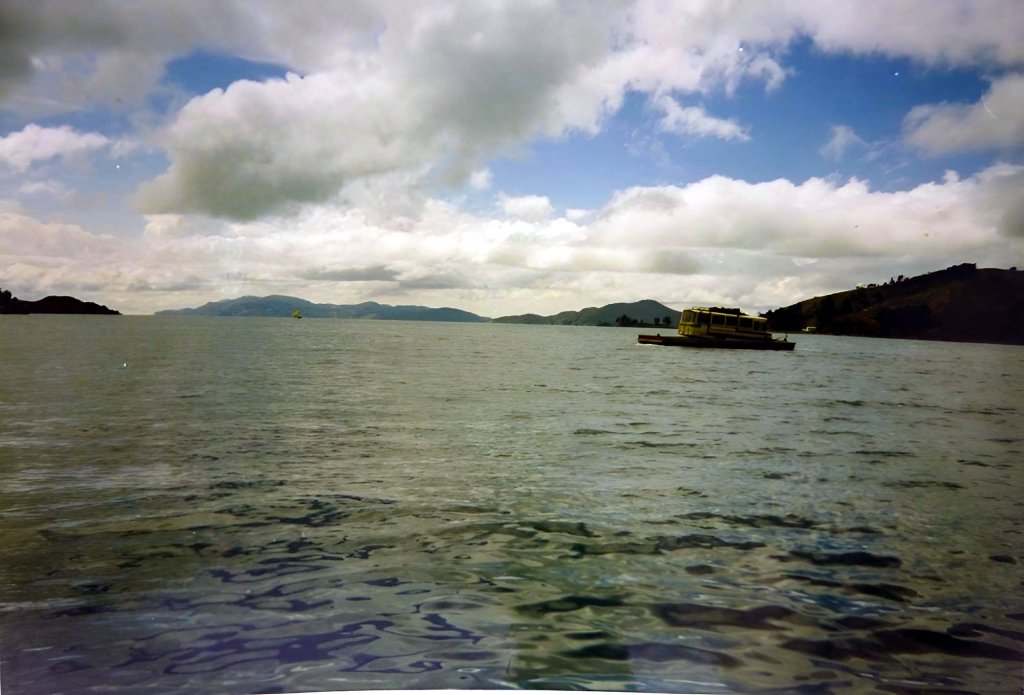
The next day, on to the Bolivian border — along the shores of Lake Titicaca, the highest navigable lake in the world. Past fields of quinoa, wheat, and potatoes.
Ahead: Copacabana – Bolivia.
The cholera that had been following in my footsteps was still a few weeks behind me.

