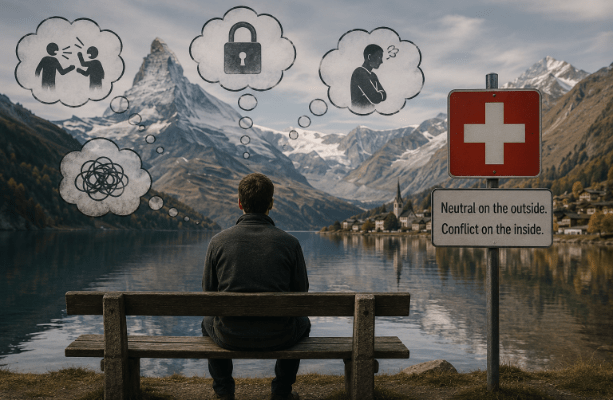
Looking Beyond the Obvious — Questioning the Invisible Rules We Live By.
Swiss neutrality doesn’t stop at the country’s borders or its foreign policy. Over time, it has become something much deeper—a mindset that shapes everyday life.
Of course, it would be ridiculous to claim that all Swiss people are the same. Every society is diverse. But cultures often develop recognizable patterns, and one of Switzerland’s seems to be a strong preference for avoiding conflict.
Many people would rather stay silent than confront someone directly. Frustration is often kept inside instead of being openly discussed. Whether at work, between neighbors, or in romantic relationships, there seems to be an unspoken rule: preserve the peace, even if something more important has to be sacrificed.
A neighbor behaves selfishly. A colleague repeatedly crosses personal boundaries. A partner never addresses problems openly. Instead of having an uncomfortable conversation, people often choose silence—not because everything is fine, but because conflict feels worse than the problem itself.
The result is a curious kind of peace. On the surface, everything appears calm and harmonious. Underneath, however, frustration, emotional distance, and quiet resignation continue to grow.
The Swiss expression “keeping your fist in your pocket” captures this perfectly. You may be angry, but you don’t show it. You have an opinion, but you keep it to yourself. You hope that, somehow, the issue will eventually disappear on its own.
But conflicts don’t disappear simply because they’re ignored. They just change shape. Open disagreements become passive aggression, gossip, polite but distant behavior, or years of unspoken resentment.
Perhaps this is the price of a society that values stability more than confrontation. Switzerland functions remarkably well because its political institutions are built on compromise and consensus. What is a strength in politics, however, can become a weakness in personal relationships. Every healthy relationship requires honesty, and honesty sometimes creates friction.
Maybe the real challenge isn’t avoiding conflict, but learning how to handle it. A respectful disagreement doesn’t destroy a relationship. Quite often, it’s exactly what allows a relationship to become genuine and honest.
Neutrality is a virtue in politics. In private life, it can sometimes become an excuse.
And perhaps Switzerland would lose none of its peaceful character if people were a little more willing to speak uncomfortable truths—before silent frustration turns into lasting emotional distance.

